Individual Development Plan Template: with three worked examples
Too many development plans are written in January and found in a drawer in December. This template links every goal to a real action, a named person and evidence that it worked, and builds in a ten-minute monthly check so the plan stays alive.
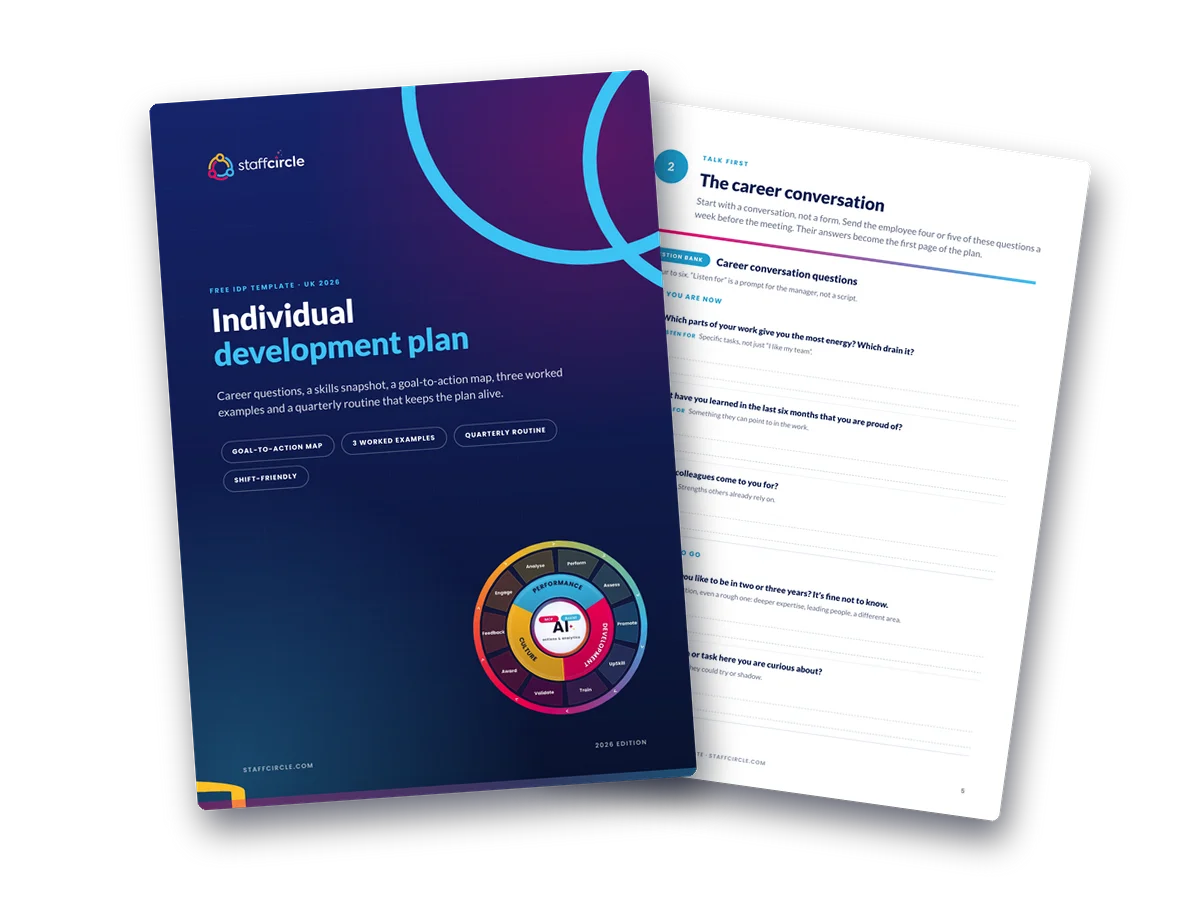
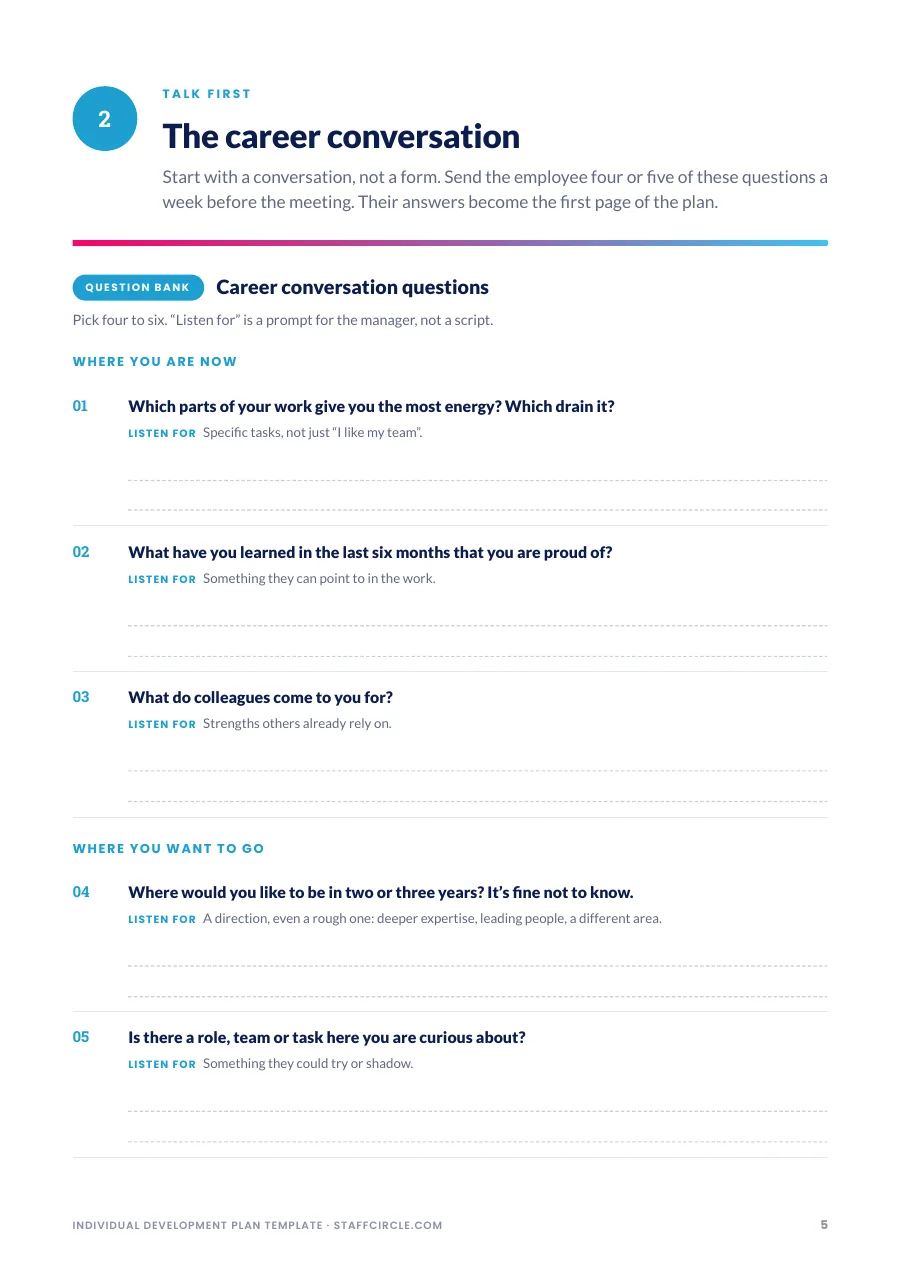
- A career conversation question bank to start the plan in the employee’s own words
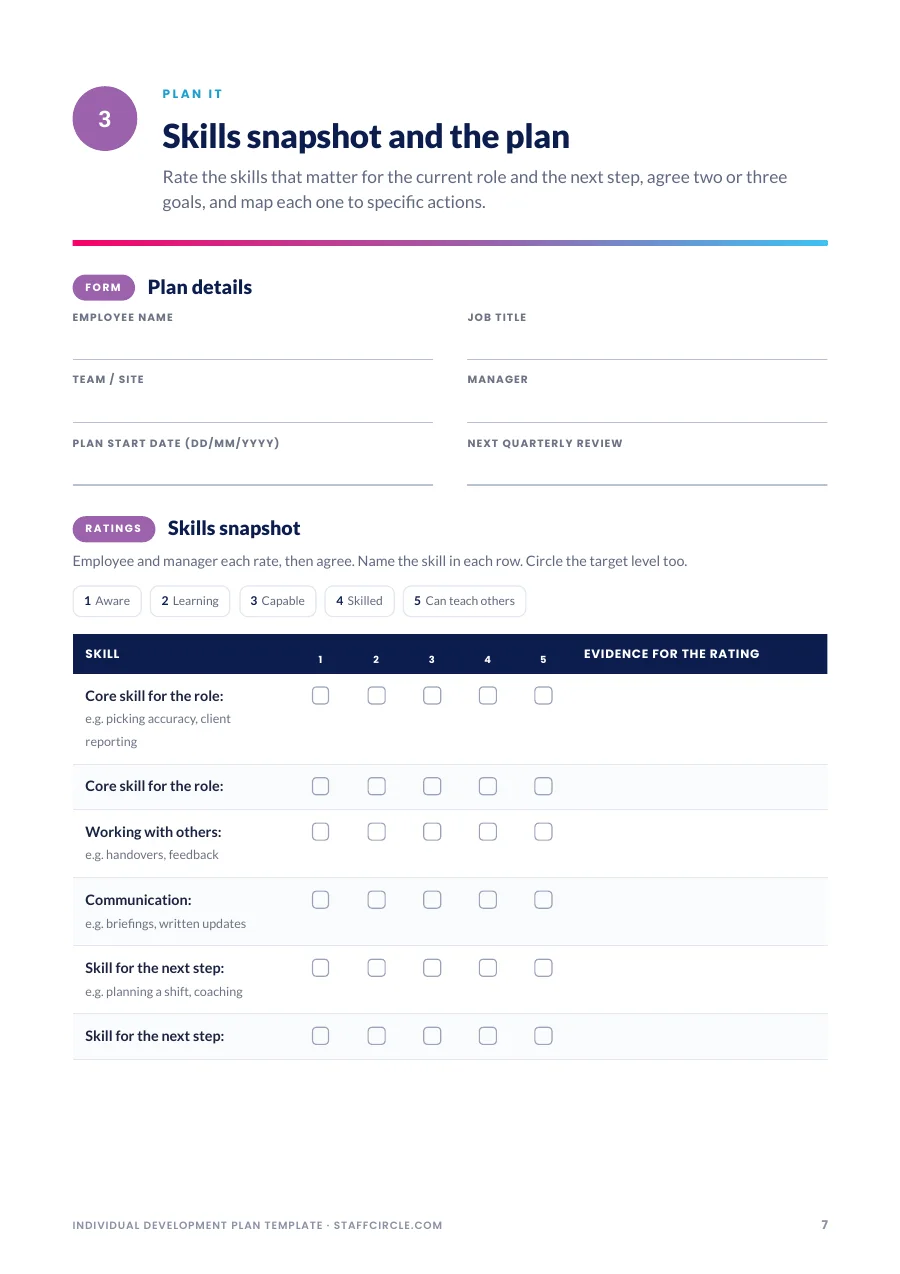
- A five-point skills snapshot grid and a goal-to-action map
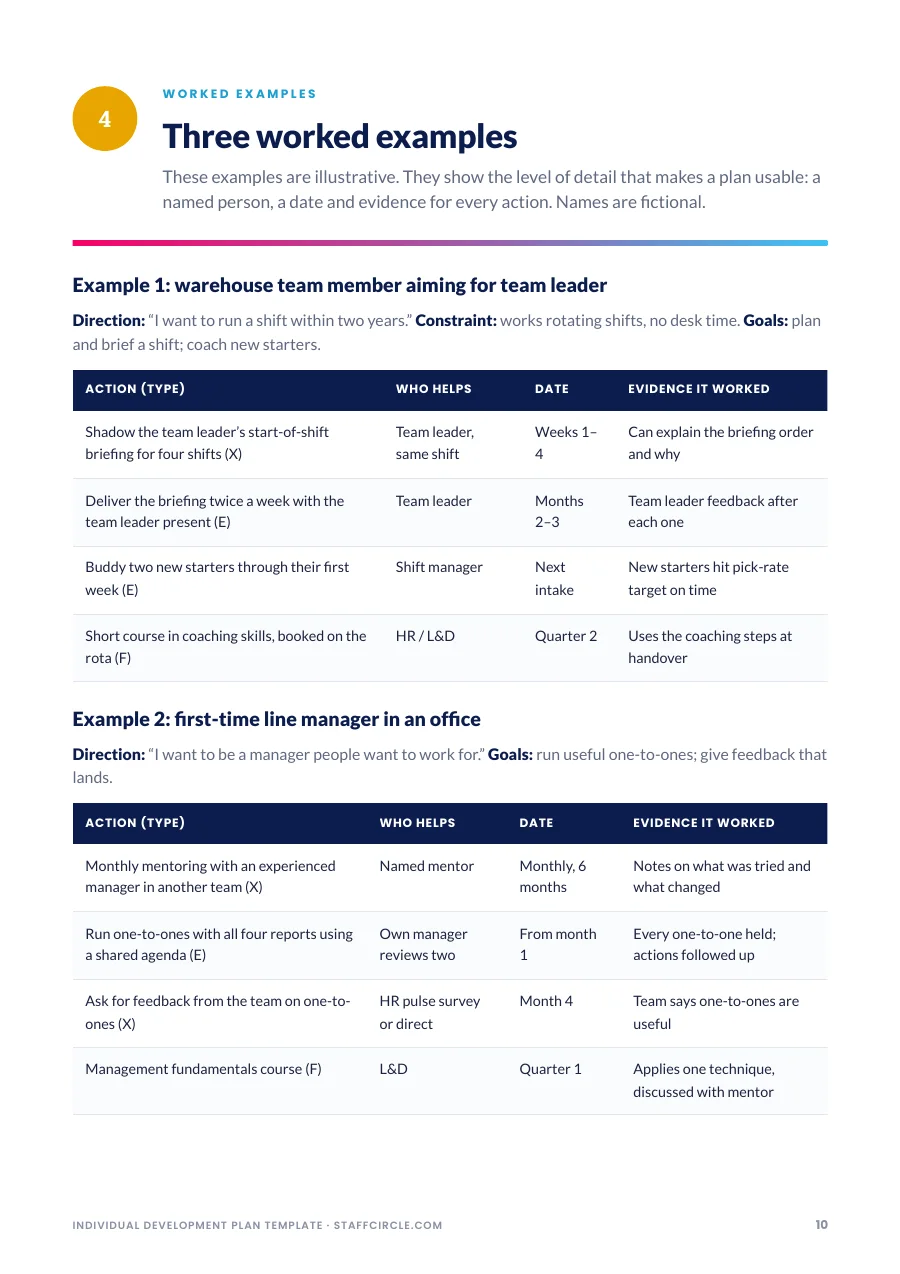
- Three worked examples, including a frontline shift role
- A monthly check and quarterly review routine with sign-off
- What the law in England, Scotland and Wales says about time off to train
Get your free template
Fill in your details to get the PDF and the editable Word version. We’ll email you the PDF too.
We’ll only use your details to send the template and relevant StaffCircle content. See our privacy policy.
Trusted by teams at leading organisations


Time is often the problem, not intent
Five steps, ready to print or edit
What 70-20-10 really tells you
Where the idea comes from, why to treat the ratio cautiously, and how to use it as a planning prompt.
The career conversation
Questions that get the employee’s ambitions on paper before anyone writes a goal.
Skills snapshot and the plan
A five-point grid, then goals mapped to actions, support and evidence.
Three worked examples
A warehouse team member, a first-time manager and a maintenance technician.
Keep it alive
A ten-minute monthly check and a quarterly review with sign-off.
Time and funding
The right to request time off for training in Great Britain, and apprenticeship units.
A development plan that survives past February
A development plan is only as good as the next conversation about it. Link every goal to an action, a person and a date, then check it every month.
Search for an individual development plan template and you will find the same layout again and again: a career goal, a list of strengths and weaknesses, and an action table with columns for resources and due dates. The layout is fine. What it rarely includes is the part that makes a plan work: a link from each goal to a specific action, a named person who will help, and evidence that the new skill is being used.
Most of the templates we reviewed are also written for someone at a desk. The actions are online courses and certificates. For a warehouse operative, a care worker or a maintenance technician, the real constraint is time away from the job. The CIPD found that only 39% of learning and development professionals believe employees are given time away from their day-to-day role to take part in learning (CIPD). A good plan works with that, not against it.
Use 70-20-10 as a prompt, not a rule
The 70-20-10 idea says most development comes from experience, some from other people, and a little from formal courses. The Center for Creative Leadership says it emerged from its long-running Lessons of Experience research (CCL). The CIPD says its ratios should be interpreted cautiously (CIPD). So don’t try to hit the numbers. Use the three categories to check each goal has more than a course attached: something to practise on the job, someone to learn from, and, where it helps, some formal learning.
What to put in an individual development plan
- The employee’s own direction. One or two sentences, in their words, about where they want to be in two or three years.
- A skills snapshot. Where they are now and where the role needs them to be, on a simple scale.
- Two or three goals, no more. Each with the gap it closes and what good will look like.
- Actions with names and dates. “Shadow Priya on the Monday stock count in May” beats “develop stock-control skills”.
- Evidence of use. What will be different in the work, and who will confirm it.
Five steps to a plan that gets used
- Start with a career conversation, not a form
- Rate the skills that matter for the role and the next role
- Map each goal to an action, a supporter and the evidence
- Check progress for ten minutes in every monthly one-to-one
- Review and re-plan properly each quarter
In England, Scotland and Wales, some employees also have a legal right to ask for time off for training. GOV.UK sets out who qualifies and how employers must respond (GOV.UK). The template covers this, alongside the new apprenticeship units for upskilling existing staff.
It comes as a printable PDF and an editable Word file. For more on structure and common failures, read our guide to employee development plans and our list of career development questions, or see how StaffCircle supports skills and development.
Individual development plans: common questions
What is an individual development plan?
An individual development plan (IDP) is a written plan, agreed between an employee and their manager, that sets out where the employee wants to grow, the skills they need, the actions they will take and how progress will be checked. It is about development, not correcting poor performance.
What should be included in an individual development plan?
A short statement of the employee’s career direction, a snapshot of current and target skills, two or three goals, specific actions with a named supporter and date for each, the evidence that will show the skill is being used, and a review and sign-off section. This template includes all of these.
Who should write the development plan, the employee or the manager?
The employee should draft it, in their own words, and the manager should shape it, agree it and commit the time and support. A plan written by the manager and signed by the employee can leave the employee feeling it isn’t theirs.
How often should an individual development plan be reviewed?
There is no legal rule. A practical rhythm is a ten-minute check in each monthly one-to-one and a fuller review each quarter, with a rewrite once a year. The CIPD describes performance management as a continuous cycle, not an isolated event.
Is the 70-20-10 model evidence-based?
It comes from research into how successful executives said they had learned, not from a measured ratio. The CIPD says its ratios should be interpreted cautiously. It is useful as a prompt to include on-the-job practice and learning from others, not just courses.
What is the difference between an IDP, a PDP and a PIP?
IDP and PDP (personal development plan) are often used for the same thing: a plan for growth. A PIP (performance improvement plan) is different. It is a formal plan to address performance that is below the required standard.
Can an employee ask for time off for training in England, Scotland or Wales?
Yes, if they qualify. GOV.UK says an employee must have worked for their employer for at least 26 weeks and at least 250 people must work in the organisation. It is a right to ask, not a right to be given the time, and time off is usually unpaid unless the employer agrees to pay. Check GOV.UK for the latest rules.
Can an employer refuse a request for time off for training?
Yes, but only for the business reasons GOV.UK lists, such as the training not benefiting the business, extra costs, or being unable to reorganise the work. The employer must accept the request or hold a meeting within 28 days, and the employee can appeal within 14 days of the decision.
How do you write a development plan for frontline or shift workers?
Build actions into the shift rather than around it: shadowing a colleague, a short learning slot at handover, covering a supervisor’s tasks with support, or a short course scheduled on the rota. Measure progress by what changes in the work, not hours of training.
Build development plans people actually use
Career questions, a skills grid, a goal-to-action map, three worked examples and a quarterly review, as PDF and Word.