BambooHR covers a broad set of HR tools, but teams often outgrow it in one area first — performance and development, payroll, global HR or workforce automation. We compare eleven alternatives on fit, pricing and HR scope, with StaffCircle our top pick for performance, development and frontline teams.
BambooHR alternatives cover the areas growing teams tend to outgrow, including performance management, payroll, IT automation, and global HR. Most of them handle reviews and employee records well. The real difference is what happens after a review: whether it turns into a development plan, a closed skills gap, and a successor who's ready when a role opens up. Here are our top three picks:
International mid-market companies that need one HCM platform
Looking for the best BambooHR alternatives?
BambooHR gives teams a broad set of HR tools, but that breadth can become a weakness when one area starts needing more depth, flexibility, or specialist support.
The search for a BambooHR alternative starts in one of three places:
A. You are choosing an HR platform and want to compare BambooHR with tools that go deeper in areas like performance, payroll, global HR, or workforce automation.
B. You already use BambooHR, but your team now needs more from competencies, succession, reporting, learning, or international employment.
C. You are happy with BambooHR for core HR, but one part of the stack needs a more specialized tool rather than a full replacement.
Cost can shape that decision too. BambooHR currently charges $10 per employee/month for Core, $17 for Pro, and $25 for Elite for companies with more than 25 employees. Performance Management starts with Pro, while Payroll, Benefits Administration, Time Tracking, and Global Employment are additional services.
So the best alternative depends on what you actually want to improve, not which platform has the longest feature list.
In this guide, we compare 11 BambooHR alternatives across pricing, HR scope, and the areas where each one fits best:
1StaffCircle– Performance, development, succession, and frontline teams
2Lattice– Structured performance and talent management
11Deel– Global employment, EOR, and international payroll
Why listen to us?
At StaffCircle, we work closely with HR teams that need more than basic HR administration, particularly around performance, competencies, development, succession, and frontline employee engagement.
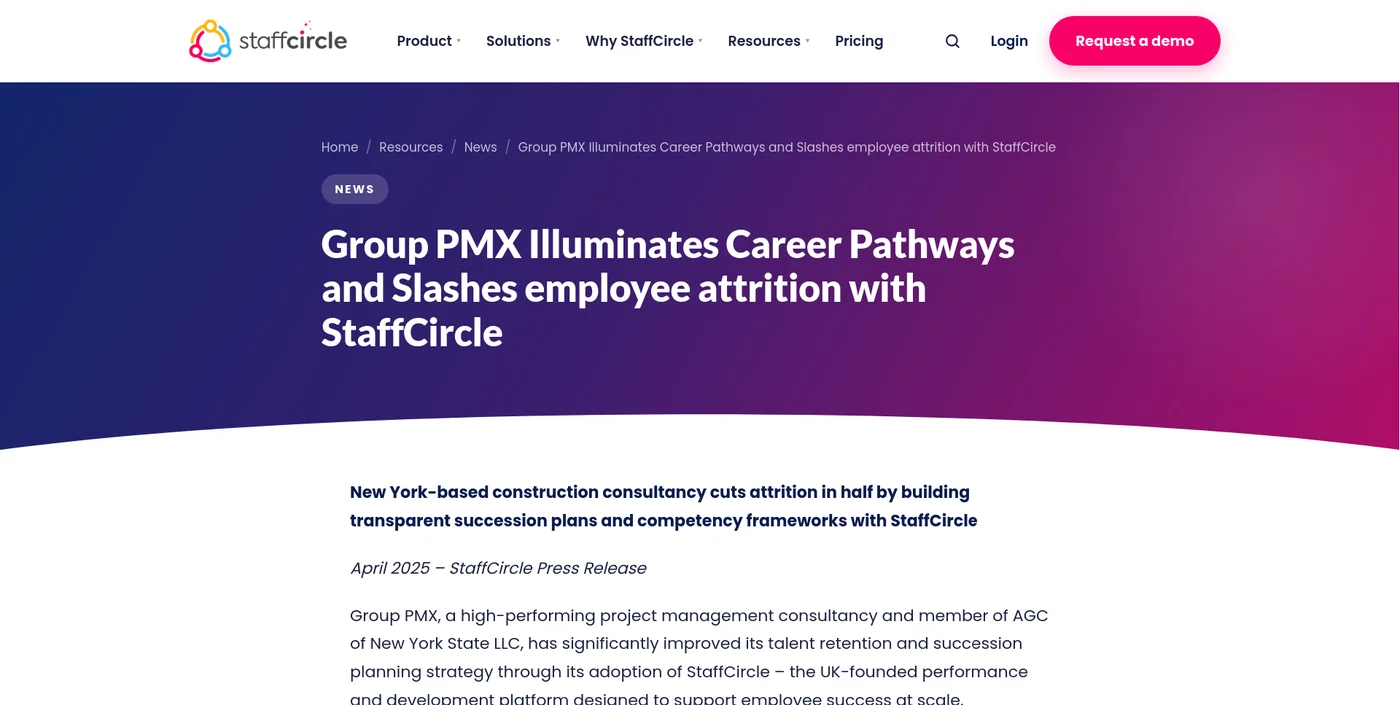
Group PMX is one example. After using StaffCircle for competency expectations, career paths, appraisals, and succession planning, the company reported cutting employee turnover in half.
For the other platforms, we checked current product pages, pricing, documentation, integrations, and customer feedback. The comparison comes down to what each platform is built to handle, not who can list the most features.
Why look for BambooHR alternatives?
BambooHR may become less suitable when your needs shift toward deeper performance management, more flexible reporting, global HR, or a different pricing structure. Here are some areas where it falls short:
Reporting and workflow customization can be restrictive
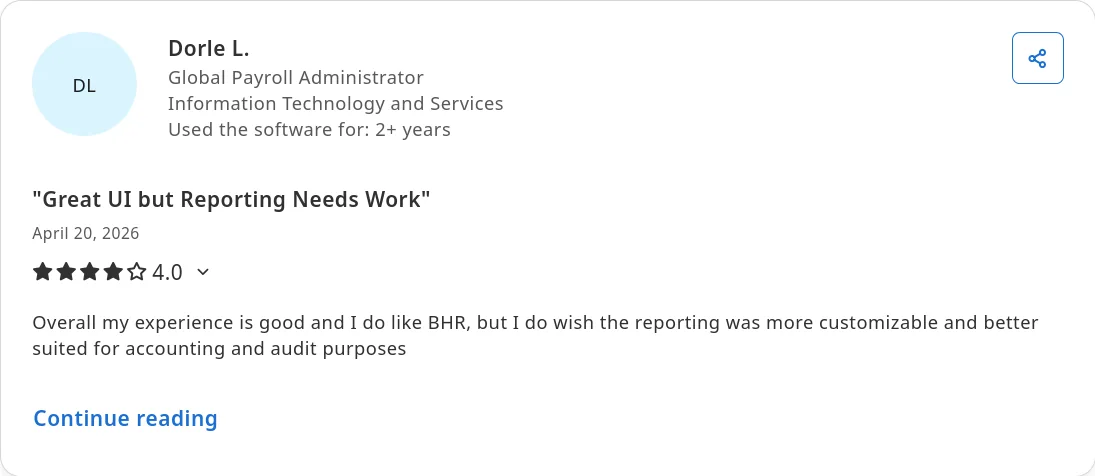
BambooHR lets you build custom reports and filter data by date. The challenge can come when finance or payroll teams need a very specific historical view.
Dorle L., a Global Payroll Administrator, said she struggled to pull data from exact prior dates and wanted reporting that was better suited to accounting and audit work.
For teams that regularly need detailed historical reports across payroll, departments, or audit periods, that lack of flexibility can become a real constraint.
Standard performance cycles may be where BambooHR stops
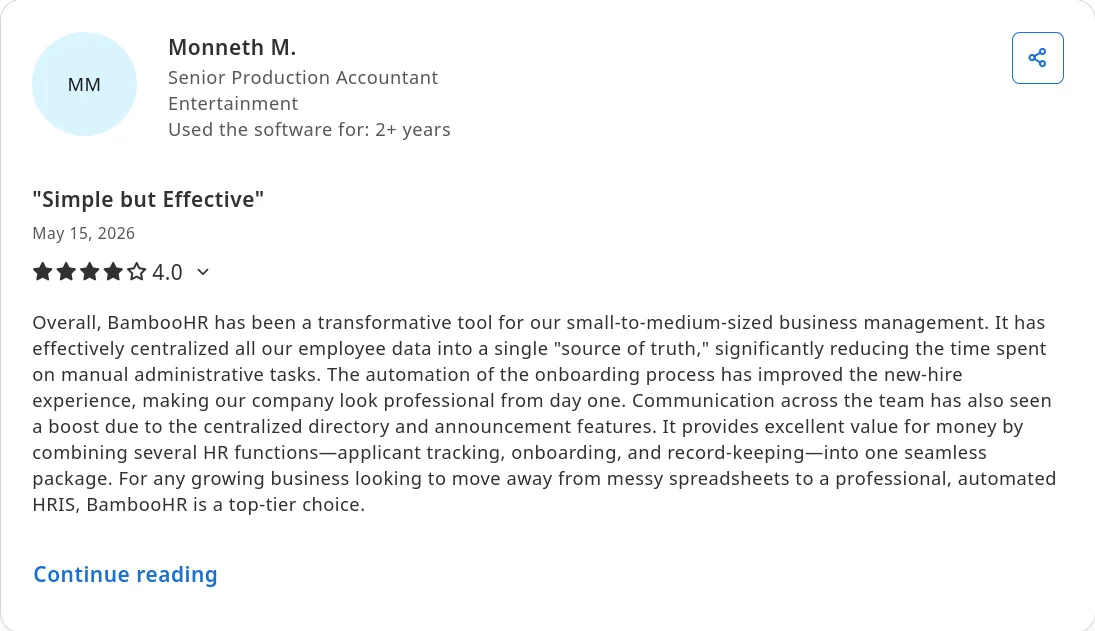
BambooHR gives teams tools for reviews, goals, 1:1s, and 360 feedback. The gap tends to show when teams want to turn those reviews into a more structured development process.
One verified reviewer, Monneth M., said BambooHR’s performance tools lacked the deeper competency mapping and customization available in specialist platforms.
That becomes important when reviews are only the first step. Teams that also want to track skills gaps, development plans, career paths, and succession may need a platform built for that level of depth.
Payroll can become the wrong place to compromise
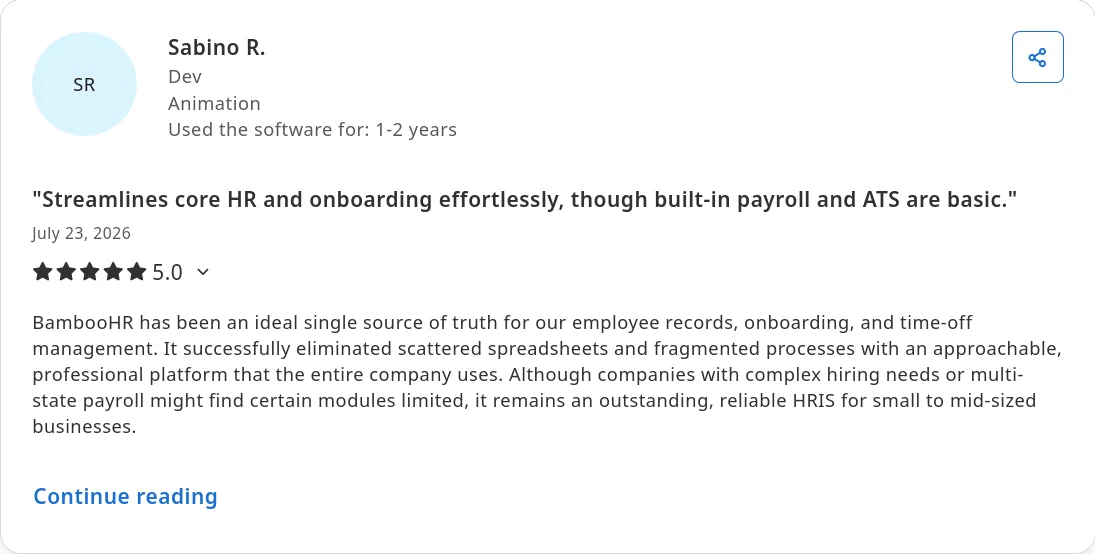
Payroll is available in BambooHR, with tax filing, direct deposit, payroll reporting, and employee data flowing into the payroll process. But it is still an add-on rather than the core of the platform
Verified reviewer Sabino R. liked BambooHR for bringing HR processes into one place, but described its built-in payroll as basic compared with more specialized options.
For a small US company where payroll, tax filing, benefits, and time tracking are the main priorities, it can make more sense to choose a platform built around payroll from the start.
International teams may hit the US bias sooner
BambooHR can support international teams, but payroll outside the US works differently. Its own payroll product is designed for US employees, while global payroll is handled through local providers, partner integrations, or BambooHR’s EOR service.
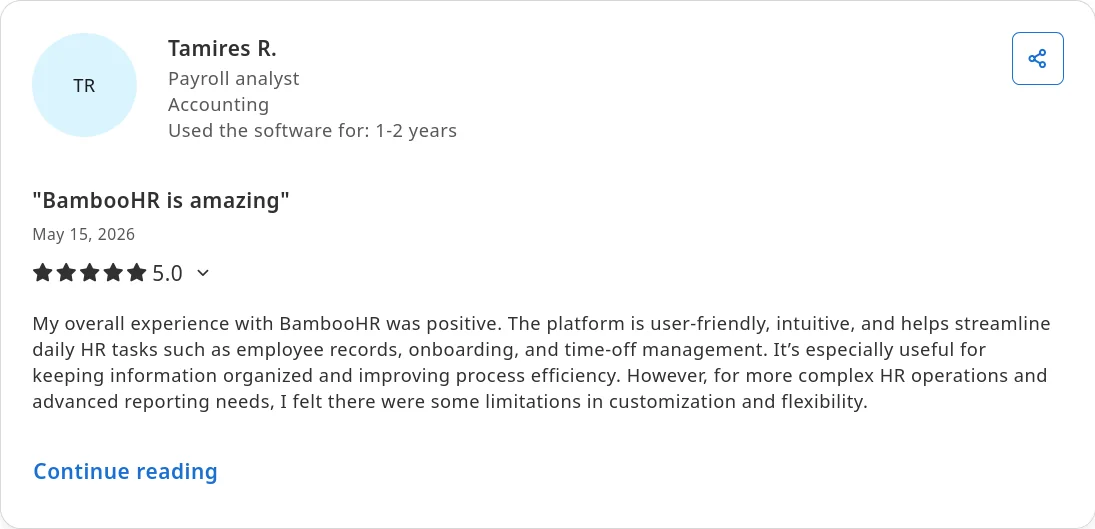
Tamires R., a Payroll Analyst, also pointed to weaker international integrations and limits around customization and people analytics in her review.
For companies hiring across several countries, the key question is how much of the payroll and employment process can stay in one system and how much will still depend on external providers.
A big HR package only pays off if you use it
BambooHR adds more capability as you move from Core to Pro and Elite. That works well if you need the wider HR suite, but it can be less efficient when only a few areas matter to your team.
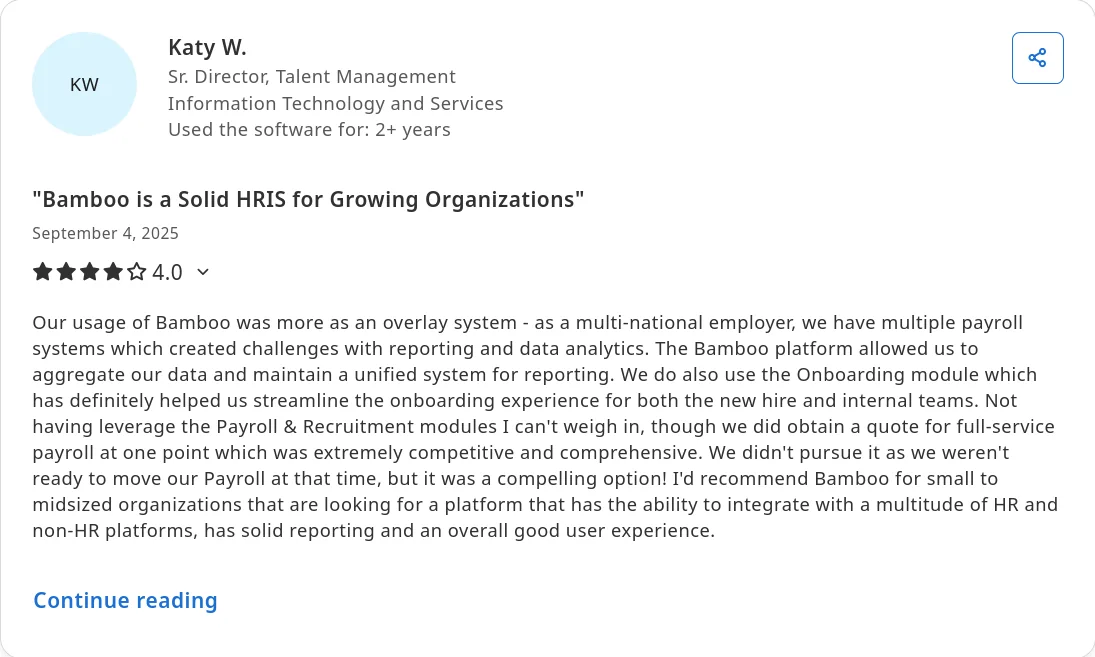
Katy W., a Sr. Director of Talent Management, said BambooHR worked well as a central HR system for her multinational company. Her review also highlights an important buying question around how much of the wider platform a team will actually use.
If your priority is mainly performance, competencies, development, or succession, compare the cost of the full HR package with a platform focused more closely on those needs.
Top 11 BambooHR alternatives you should compare
Who each platform suits, the need it covers best, its published starting price and how much of the HR stack it takes on.
Pricing as published by each vendor and last reviewed October 2026. Plans, currencies and minimums change — always confirm current pricing directly with each vendor. BambooHR, Lattice, 15Five, Culture Amp, Leapsome, PerformYard, Appraisd, Rippling, HiBob, Gusto and Deel are trademarks of their respective owners.
1Our top pick
StaffCircle
Best forOrganizations with 50 to 1,000 employees that want performance, employee development, succession planning, and access for office, hybrid, remote, and frontline teams.
StaffCircle is a stronger BambooHR alternative for teams that want to go deeper on performance, skills, development, and succession without replacing their entire HR stack.
Its AI Competency Framework builds role-based competency frameworks and enriches them with skills, job descriptions, and progression paths. Those skills can then feed into Objectives & Reviews, where managers can assess employees against their role profile and see skill gaps alongside performance.
StaffCircle also brings in several tools that extend the process beyond the review itself.
Build role-based skills: AI Competency Framework creates and updates competencies, skills, and progression paths for each role.
Connect goals and reviews: Objectives & Reviews brings goals, reviews, OKRs, and skills assessments into one workflow.
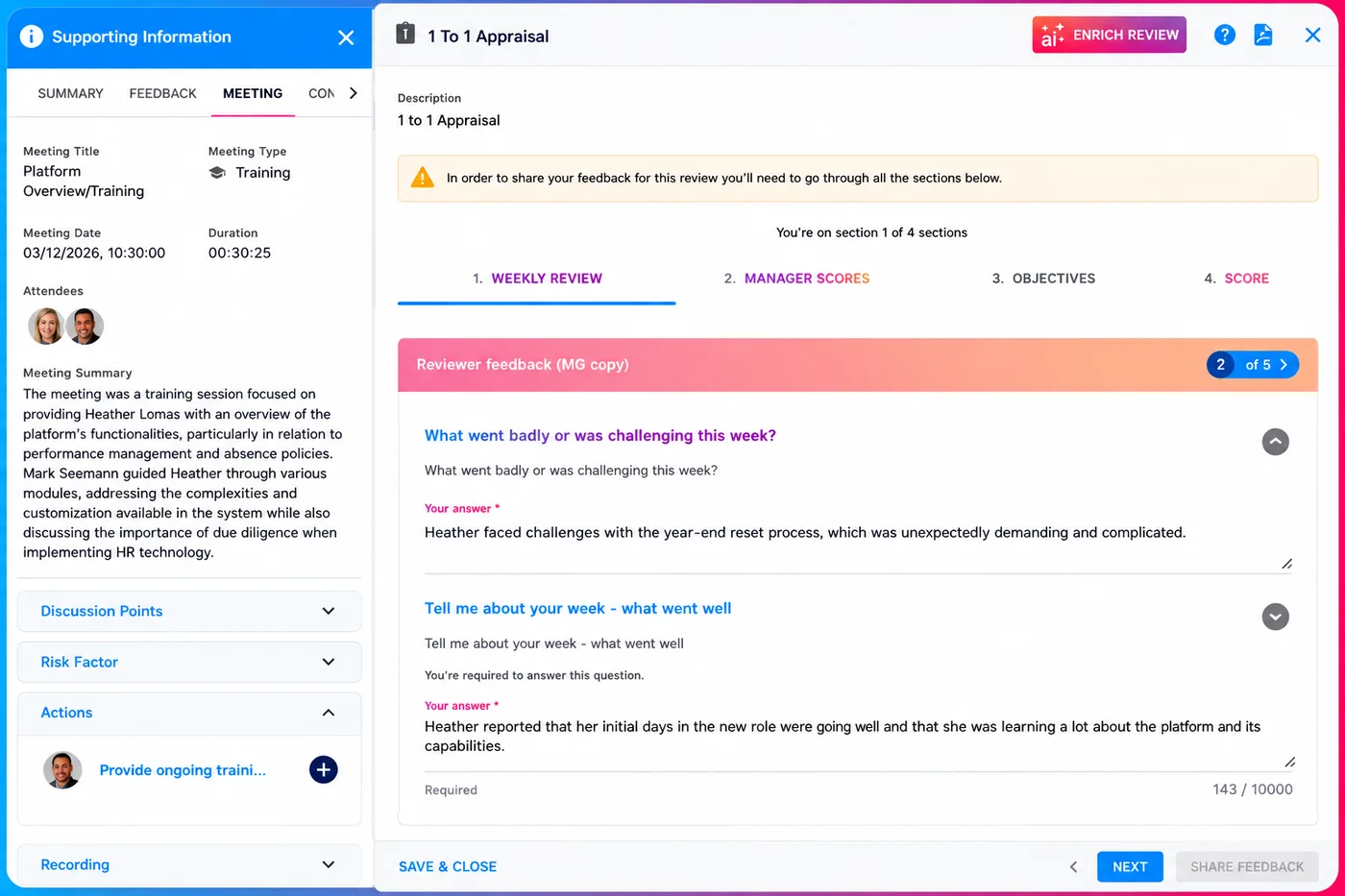
Capture better 1:1s:Notetaker records and summarizes meetings, then turns those conversations into useful performance data.
Use live people data:AI Assist helps HR and managers generate reports, talent maps, feedback, and review content from current employee data.
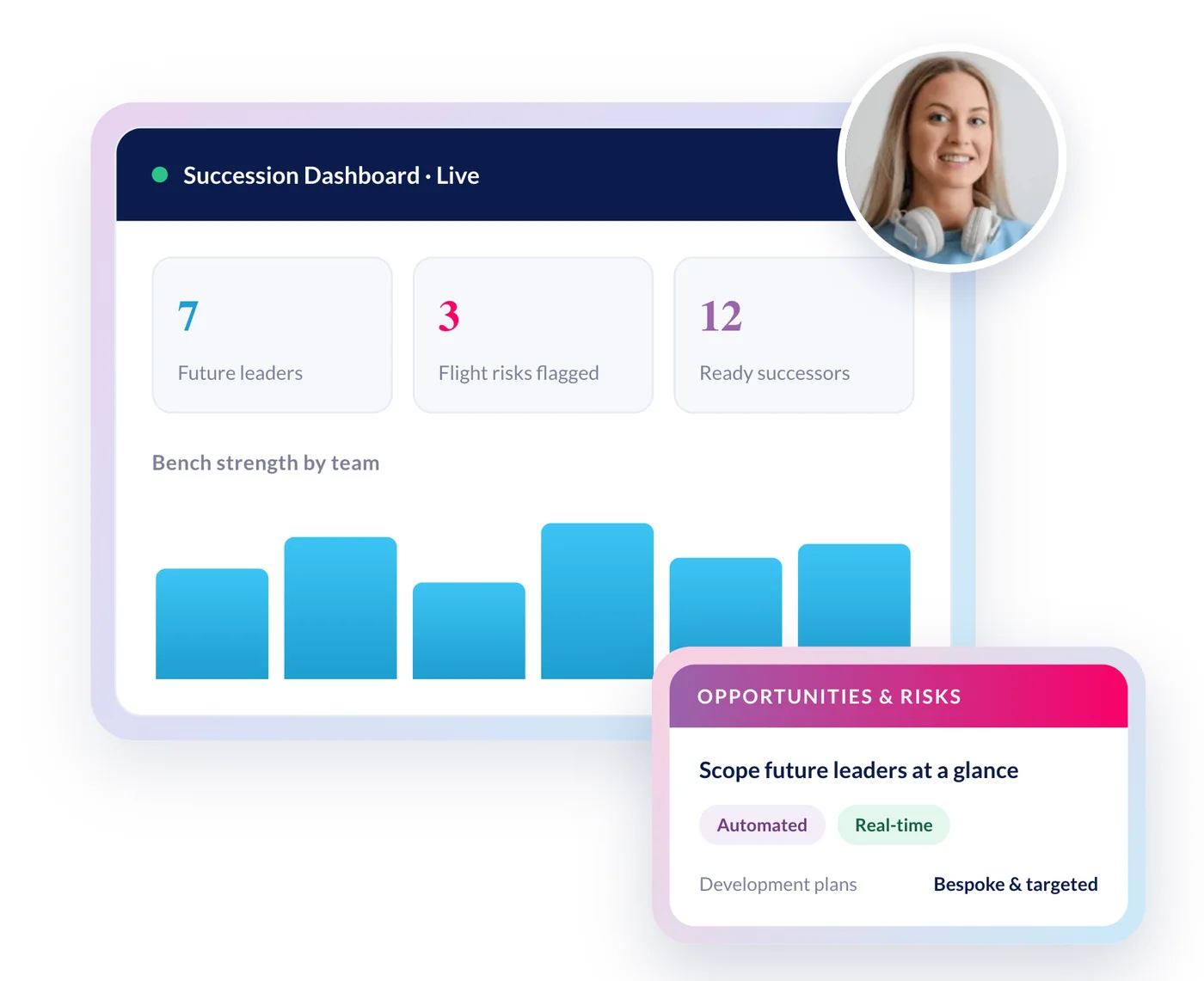
Keep succession plans current:Success Circles™ uses live performance, skills, and development data to show readiness and future talent.
Plan development clearly:Career Explorer & Pathways connect current skills with progression, development, and future role needs.
Why StaffCircle is our top BambooHR alternative
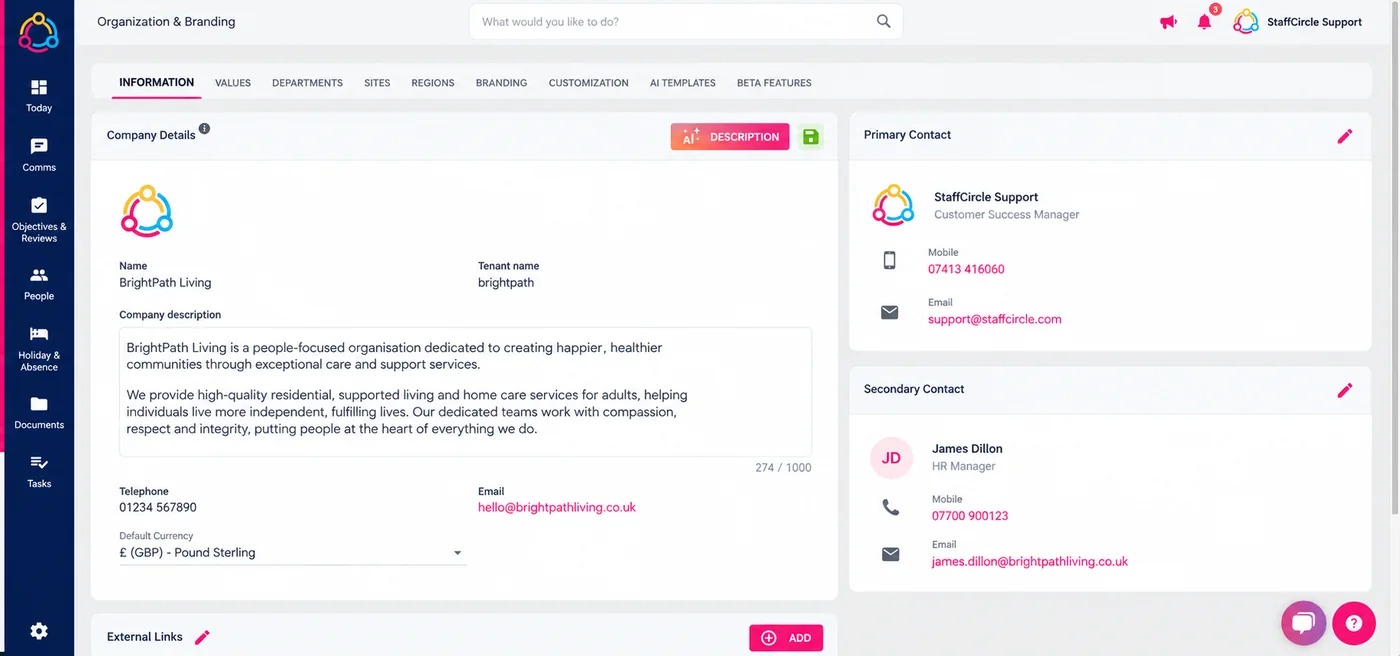
You do not necessarily have to replace your existing HR setup to use StaffCircle. It connects directly with BambooHR and 50+ other HRIS platforms, letting teams keep core employee data where it already lives while adding a more focused performance and development layer.
A few practical differences stand out.
Keep your HRIS and sync data from BambooHR, HiBob, Workday, ADP, and others.
Choose the modules you need instead of buying one fixed package.
Extend reporting with Custom Insights, Power BI, APIs, and webhooks.
Use AI without per-user fees through AI Assist.
Configuration and training are included during setup, and most customers go live within weeks.
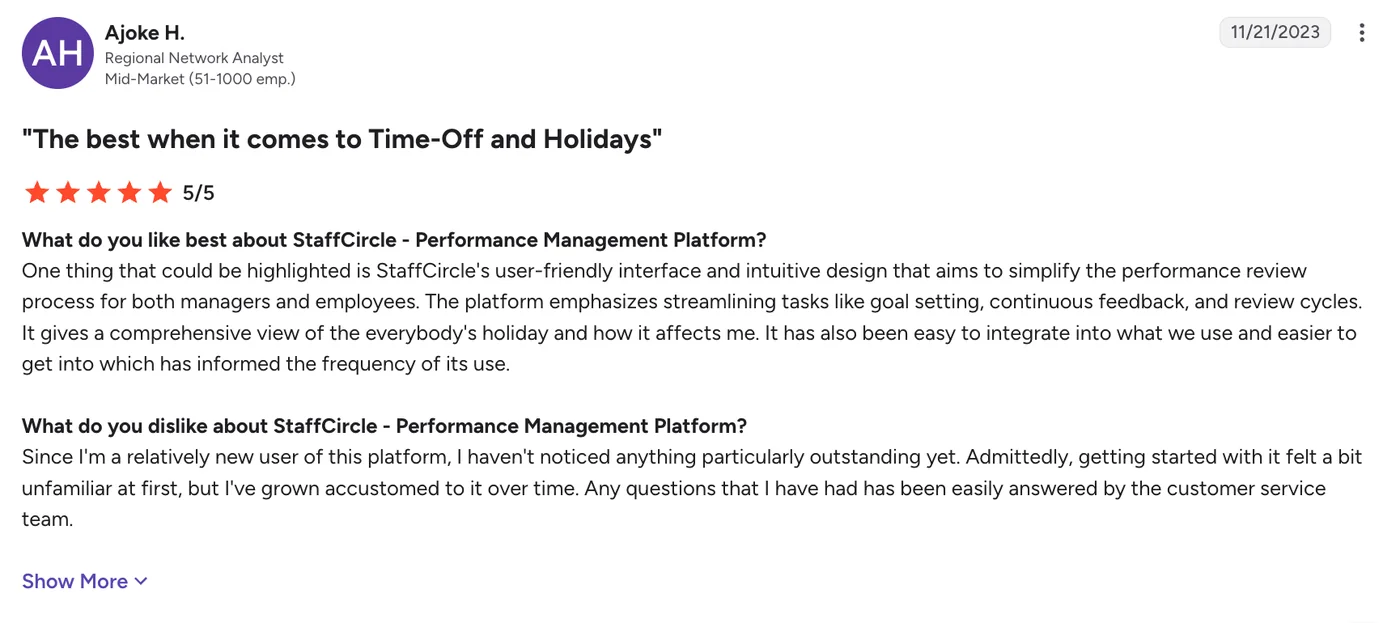
That implementation piece also comes up in user feedback. One verified G2 reviewer said:
The biggest differences between StaffCircle and BambooHR show up in these areas:
#1. Competencies sit closer to the performance process
BambooHR covers custom reviews, 360 feedback, goals, and 1:1s. Its current performance feature set does not include a dedicated competency framework tool.
StaffCircle adds that layer through its AI Competency Framework. Teams can define the skills, behaviours, and proficiency levels expected for each role, then use the same framework across reviews and employee development.
This is useful when managers need to answer more than “How is this person performing?” They can also see what skills are missing and what someone needs to develop for their next role.
#2. Succession planning is built into the platform
BambooHR publishes guidance on succession planning, but its current product and pricing pages do not list a dedicated succession planning feature.
StaffCircle has Success Circles™, which brings together reviews, objectives, skills, and other employee signals to show readiness and potential successors.
That gives HR a live view of the talent pipeline instead of building succession plans separately from the performance system.
#3. Both support mobile, but StaffCircle removes more frontline friction
BambooHR has a capable iOS and Android app. Employees can complete performance assessments, update goals, request time off, and access other HR tasks from mobile.
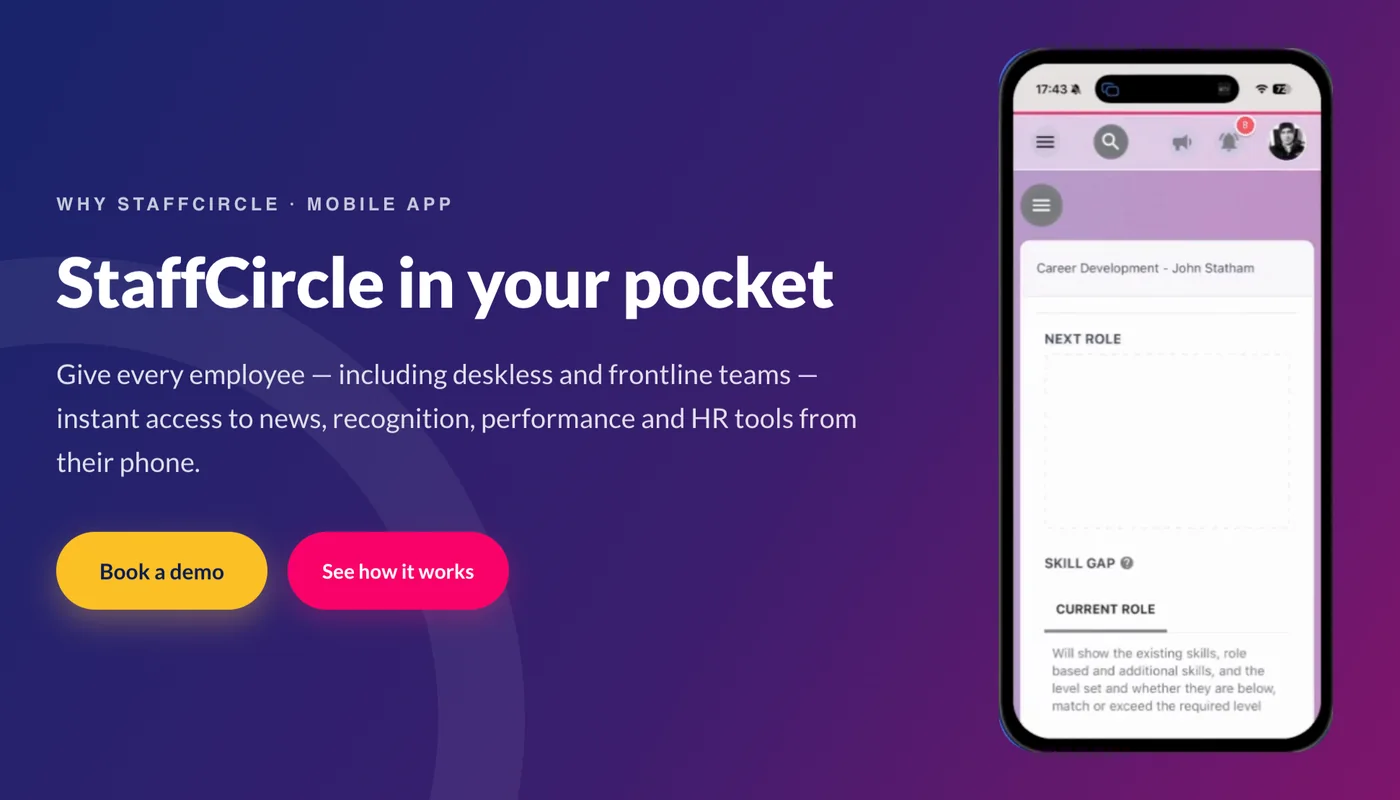
StaffCircle takes a slightly different approach for deskless teams. Its web app can be added directly to a phone without an App Store or Google Play download, and Microsoft 365 is not required for access.
That can make rollout easier in manufacturing, care, hospitality, construction, and other workforces where not every employee has the same corporate IT setup.
#4. 1:1 conversations can feed directly into future reviews
BambooHR’s 1:1 tools let managers schedule meetings, set agendas, keep notes, and track previous conversations.
StaffCircle adds Notetaker, which can transcribe and summarise meetings, identify actions and signals, and feed that information into its wider performance data.
AI Assist can then use data from meetings, reviews, skills, and engagement when creating reports, talent maps, feedback, or manager guidance. This reduces the need to manually carry useful information from a 1:1 into the next review.
#5. StaffCircle can sit alongside BambooHR instead of replacing it
BambooHR is designed to become the central HR system, covering employee records, hiring, onboarding, time off, reporting, and other HR processes alongside performance.
StaffCircle can work as the specialist performance and development layer on top of an existing HRIS. It connects directly with BambooHR as well as Personio, HiBob, Workday, ADP, UKG, Dayforce, and dozens of other HR platforms.
So if the HRIS itself is working fine and the main gap is performance, skills, or succession, you may not need to replace the whole stack.
#6. The pricing models reflect that difference
BambooHR Performance Management starts with Pro at $17 per employee per month. That price also includes the wider BambooHR HR platform rather than performance alone.
StaffCircle starts from £3.85 per employee per month, billed annually, and lets teams build around the modules they need. There is also a £2,600 one-off setup fee for configuration and training.
The prices are not directly like-for-like. BambooHR is the broader HR suite, while StaffCircle gives teams the option to invest more specifically in performance and employee development.
Key StaffCircle features
StaffCircle supports structured performance reviews, 1:1s, objectives, and ongoing feedback.
Its AI Competency Framework helps teams build role-based skills and competency models.
Employee development tools connect skills gaps with learning plans and career progression.
Success Circles™ helps HR teams manage succession planning using live employee data.
AI Assist helps managers create reports, feedback, objectives, and talent insights from workforce data.
Notetaker records and summarizes meetings and turns key points into useful performance information.
Employee engagement tools include surveys, recognition, eNPS, and internal communication features.
Custom Insights gives HR teams more flexibility with reporting, APIs, and Power BI connections.
Mobile access lets frontline and deskless employees use performance and development tools without relying on a desktop.
Pros
Automation helps reduce manual performance management work and saves HR teams time.
Goal tracking makes it easier to keep objectives visible and support more consistent performance reviews.
StaffCircle regularly adds new features and updates, which helps the platform stay current.
Its engagement tools can help keep employees more involved in reviews, goals, and wider people processes.
Modern performance features make it easier to automate routine tasks without losing visibility across teams.
Cons
Limited integrations can also make it harder to pull data together across different systems.
Some users mention a learning curve, particularly when adding notes or working through performance reviews.
StaffCircle pricing
StaffCircle uses modular pricing, starting at £3.85 per employee per month. Companies can start with Performance Management or Employee Development, then combine either with Employee Engagement, Notetaker, or Custom Insights AI.
A single setup fee applies, while final cost depends on employee count and selected modules.
2Performance & talent decisions
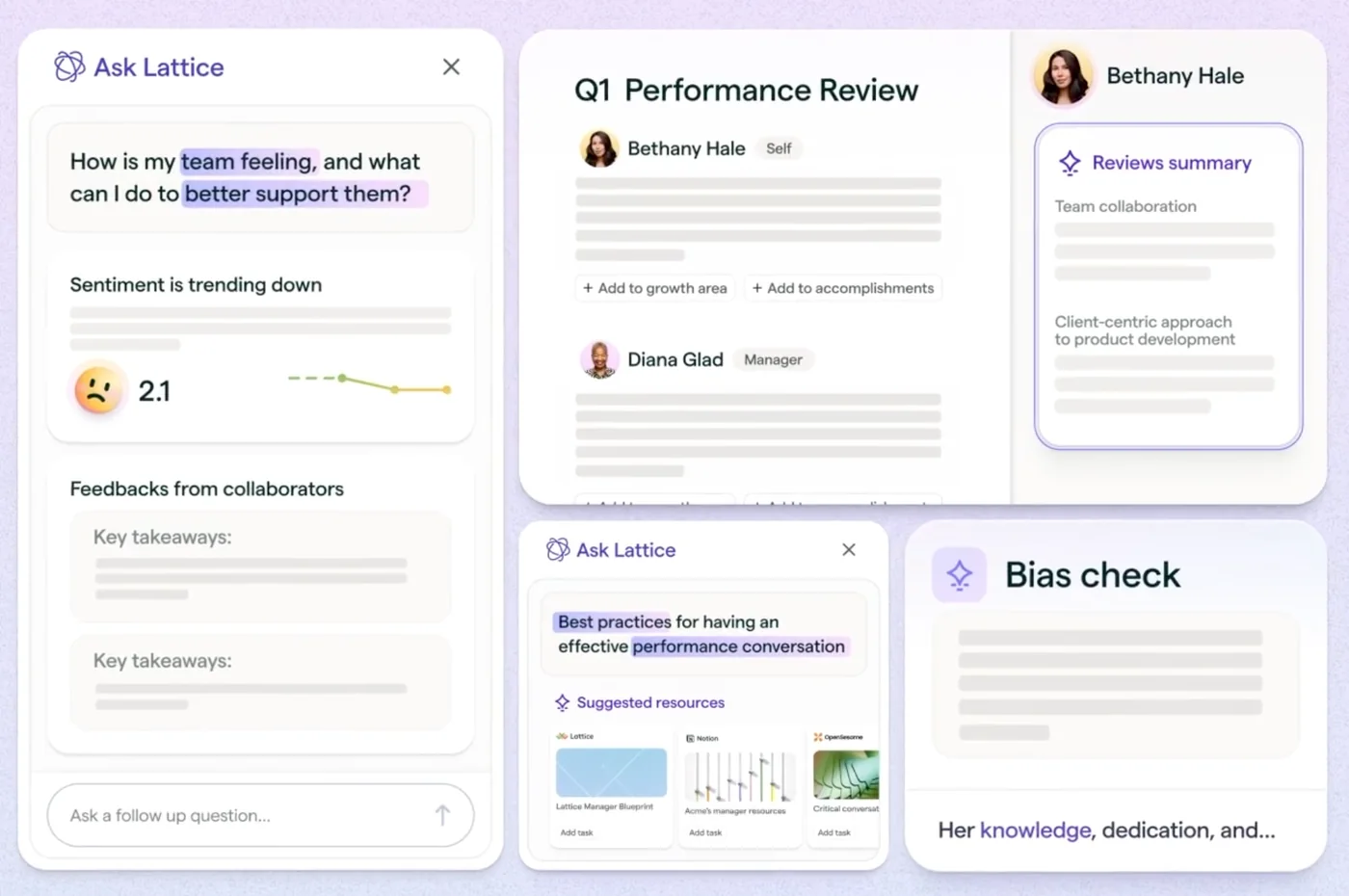
Lattice
Best forRunning the full review cycle with calibration, promotions, and PIPs.
Lattice is a performance and talent management platform for running reviews, 1:1s, goals, feedback, talent reviews, succession planning, and PIPs, with an AI Agent that drafts reviews, takes 1:1 notes, and suggests actions. It suits mid-sized and enterprise teams that want a structured, rigorous review process with strong governance around ratings and promotions.
Why Lattice is a strong BambooHR alternative
Lattice goes further on the decisions that follow a review. Lattice Performance includes calibration, promotions, PIPs, and talent reviews, and the AI Agent comes with Lattice products at no separate AI fee.
BambooHR's Pro plan includes reviews, 360° feedback, 1:1s, goals, recognition, and reporting alongside the core HRIS. It doesn't offer the same depth of calibration and promotion workflows, so HR teams running formal rating cycles across several departments get more structure from Lattice.
The main limitation is scope. Lattice ended payroll on March 31, 2026, and shut down its HRIS on July 31, 2026, so it now needs to be paired with a separate HRIS.
Calibration lets managers and HR compare ratings across teams before finalizing results, keeping scoring consistent across departments
Promotions and PIPs run inside the same platform as reviews, so the evidence behind each decision stays in one place
Talent reviews connect directly with performance reviews and growth areas
The AI Agent captures 1:1s, turns them into notes and follow-ups, drafts reviews, and gives managers coaching based on existing Lattice data
1:1s, feedback, and weekly updates are included with Performance, Goals and Engagement
The Grow add-on holds competencies, IDPs, and career tracks for teams that want career development connected to performance
Pros
Lattice Performance includes succession planning, talent reviews, promotions, PIPs, and calibration
AI Agent is included without a separate AI fee
Succession plans connect directly with performance reviews, talent reviews and growth areas
1:1s, feedback and weekly updates come included with Performance, Goals and Engagement
Cons
A $4,000 minimum annual agreement makes Lattice harder for smaller teams to justify
Grow and Compensation cost extra, so pricing climbs if you need several parts of the platform
Lattice pricing
All Lattice contracts are billed annually with a $4,000 minimum annual agreement:
Foundations: $13 per seat/month
Performance: $10 per seat/month
Goals & OKRs: $8 per seat/month
Engagement: $4 per seat/month
Grow: +$4 per seat/month
Compensation: +$6 per seat/month
Enterprise: Custom pricing
3Manager effectiveness
15Five
Best forBuilding better managers through weekly check-ins and coaching.
15Five is a performance management platform focused on keeping managers and employees aligned between formal reviews. It combines weekly Check-ins, 1:1s, goals, 360° reviews, engagement surveys, recognition, and talent planning, with Growth Studio adding tools for IDPs, PIPs, succession nominations, and the 9-box Talent Matrix.
Why 15Five is a strong BambooHR alternative
The bigger difference is how much attention 15Five gives to manager effectiveness. Its Manager Effectiveness Indicator uses manager assessments alongside performance and engagement data to show where managers are doing well and where they need support.
BambooHR includes 1:1s, goals, custom review cycles, and 360° feedback in Pro, but those tools sit inside a much broader HR platform. 15Five adds a more dedicated manager layer with Kona AI, coaching, manager training, and ongoing effectiveness insights.
That makes it a stronger option when improving day-to-day management is the priority. The downside is that Kona AI Assistant and manager coaching products are add-ons, so the cost can increase beyond the core Perform plan.
Weekly check-ins capture progress, priorities, and blockers each week, so managers spot problems long before the annual review
Employees use the iOS and Android apps for check-ins, 1:1s, High Fives, notifications, and other everyday tasks
High Fives let employees recognize colleagues publicly, keeping recognition tied to day-to-day work
Kona Meeting Assistant produces notes, summaries, performance snapshots, and action items from manager conversations
The Growth Studio Talent Matrix uses a 9-box grid to flag high performers, potential successors, and employees who need development, with routes into IDPs, PIPs, and succession nominations
Team OKRs give goal setting a clear structure, and G2 users rate the feature highly
Pros
Regular check-ins and 1:1s make it easier for managers to keep feedback and priorities visible between formal reviews.
Goal tracking is simple to follow and helps teams connect weekly work with wider objectives.
Recognition and engagement tools support more frequent communication across teams.
Reviewers often praise the interface for making performance conversations easy to manage.
Cons
Reporting and customization can feel limited for teams with more complex structures or workflows.
Some users mention a learning curve once they move beyond the core check-in and goal features.
15Five pricing
15Five sells its platform per user, with AI tools priced separately. Both core plans are billed annually:
Perform: $11 per user/month
Total Platform: $16 per user/month
Kona Meeting Assistant: +$2 per employee/month
Kona Coach: $19 per manager/month
4Engagement-led performance
Culture Amp
Best forBenchmarking engagement against similar companies.
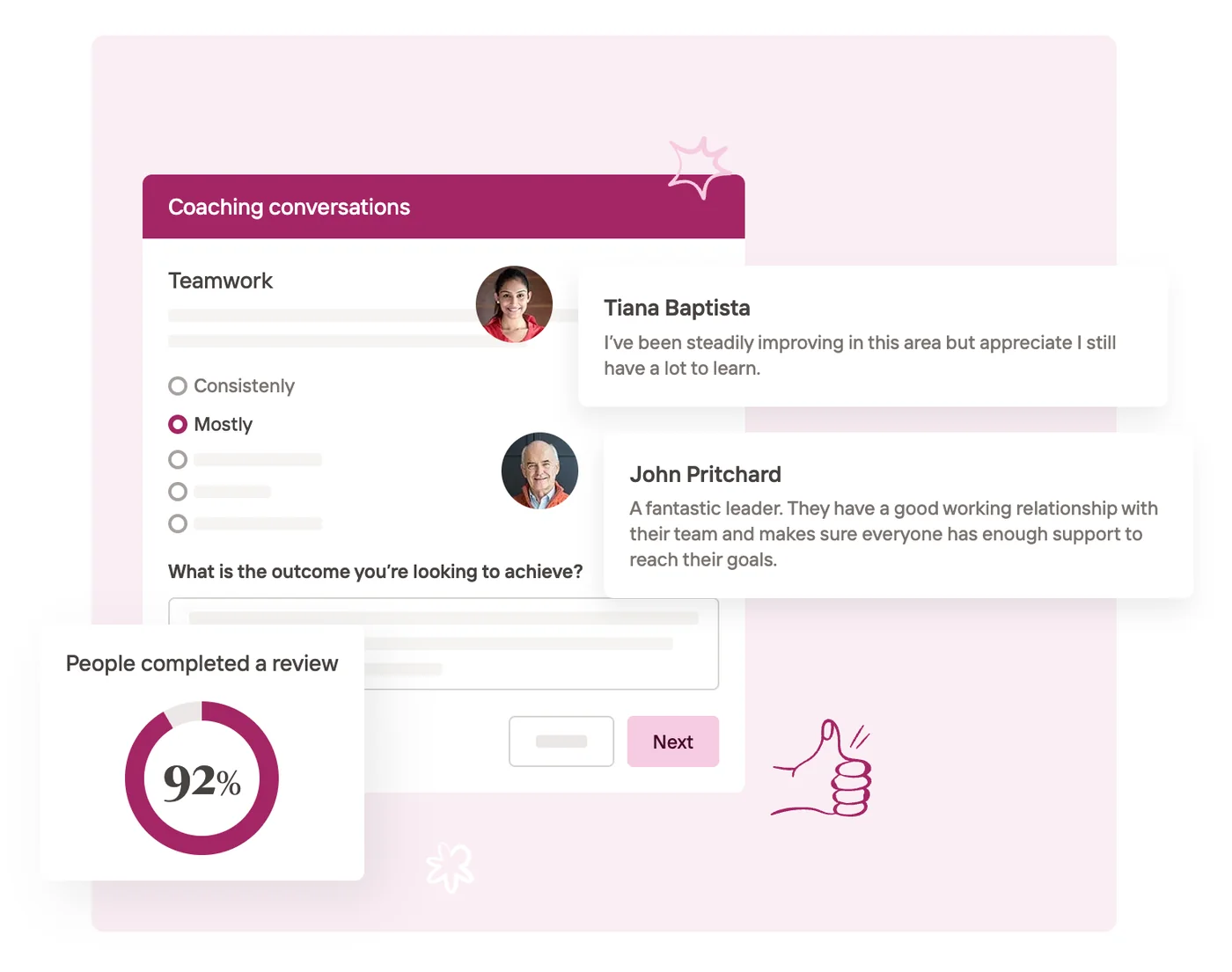
Culture Amp suits teams that want performance decisions backed by solid engagement data. Its Perform module covers reviews, goals, 1:1s, calibration, feedback and development, while Engage adds surveys, benchmarks, retention insights and action planning, so HR can read performance and engagement together.
Why Culture Amp is a strong BambooHR alternative
Culture Amp gives engagement data more context. Its benchmarks draw on more than 1 billion survey responses, so HR teams can compare results with similar companies, industries, and regions instead of looking at scores in isolation.
BambooHR includes eNPS and employee satisfaction tools, which work well for regular pulse checks. Culture Amp goes deeper with benchmark comparisons, retention insights, and more detailed engagement analysis.
That makes Culture Amp a better fit for teams that treat engagement as an ongoing people strategy rather than a simple survey process.
One thing to note is pricing. Culture Amp uses custom quotes and does not publish a starting price.
Key Culture Amp features
Engagement benchmarks built on more than 1 billion survey responses show how your scores compare with similar companies, industries, and regions
Engagement and pulse surveys feed into manager action plans, so results lead to follow-up instead of sitting in a report
Retention insights point to the groups most likely to leave before turnover shows up
The Perform module runs reviews, goals, 1:1s, calibration, feedback, and development alongside the engagement data
AI Coach supports managers with review writing, tougher conversations, and follow-up actions from engagement results
1:1 templates, HRIS integrations, SSO, and Slack and Microsoft Teams integrations are included across plans
Pros
AI Coach is included across plans
Performance and engagement are managed in the same platform
Development plans connect employee goals with competencies and growth areas
Core integrations and SSO come standard on every plan
Cons
Culture Amp doesn't publish starting prices, and People Science Consulting costs extra
AI Coach doesn't currently use goals or 1:1s as data sources when supporting reviews
Culture Amp pricing
Culture Amp uses custom annual pricing:
Quotes depend on employee count, selected products, and service tier
All subscriptions are billed annually
5Performance & learning
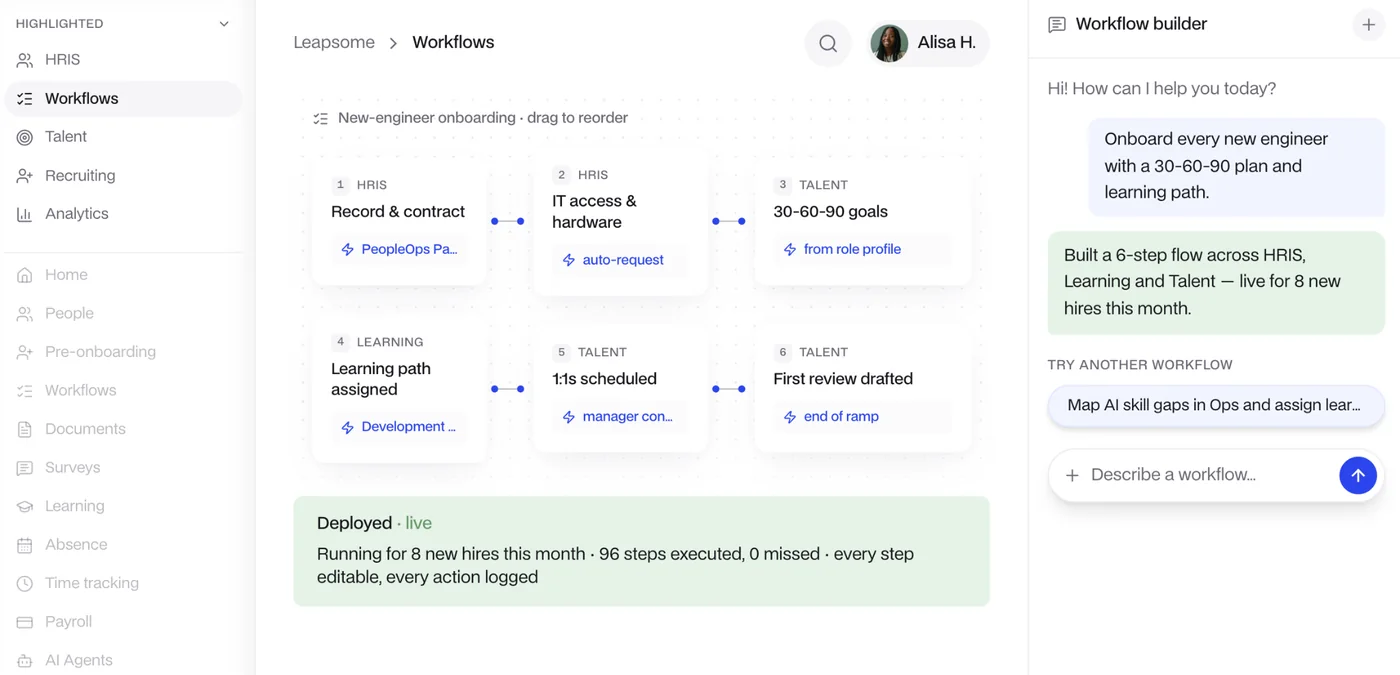
Leapsome
Best forTying performance reviews to learning paths.
Leapsome is a people platform that covers reviews and goals alongside engagement surveys, learning, competency frameworks, compensation, an optional HRIS, and more, and more than 2,000 organizations use it. It's aimed at companies with 50 to 2,000 employees that want review outcomes to lead directly into structured learning.
Why Leapsome is a strong BambooHR alternative
Leapsome connects performance with learning more closely. Feedback from reviews can lead into development goals, competency-based learning paths, and assigned training in the same platform, so development does not have to sit in a separate system.
BambooHR does offer training resources for customers, but its current product does not position a built-in employee LMS for managing workforce learning in the same way.
That makes Leapsome a better fit when L&D is closely tied to performance and career growth. The catch is setup. Reviews, permissions, templates, and learning workflows can take more time to configure properly.
Key Leapsome features
Learning paths link courses directly to each employee's development goals
HR can run 360°, project-based, leadership, and external reviews
The AI Review Assistant pulls in existing performance context so managers write more informed feedback
Meetings, Instant Feedback and Competency Frameworks are included in every plan at no extra cost
Engagement surveys sit alongside performance data for a fuller view of each team
Compensation management and an optional HRIS let teams run pay reviews and employee records in the same platform
Pros
Reviews can draw on goals, competencies, feedback and meeting data for more context
Learning paths connect directly with development goals
Review workflows are highly customizable and can be automated
Cons
Leapsome doesn't publish fixed prices, and every contract has a minimum one-year term
Dedicated Customer Success requires at least $6,000 or €6,000 in annual spend
Leapsome pricing
Leapsome uses modular, per-employee pricing:
Quotes depend on company size, selected modules, and contract length
A 14-day free trial is available
6Flexible review processes
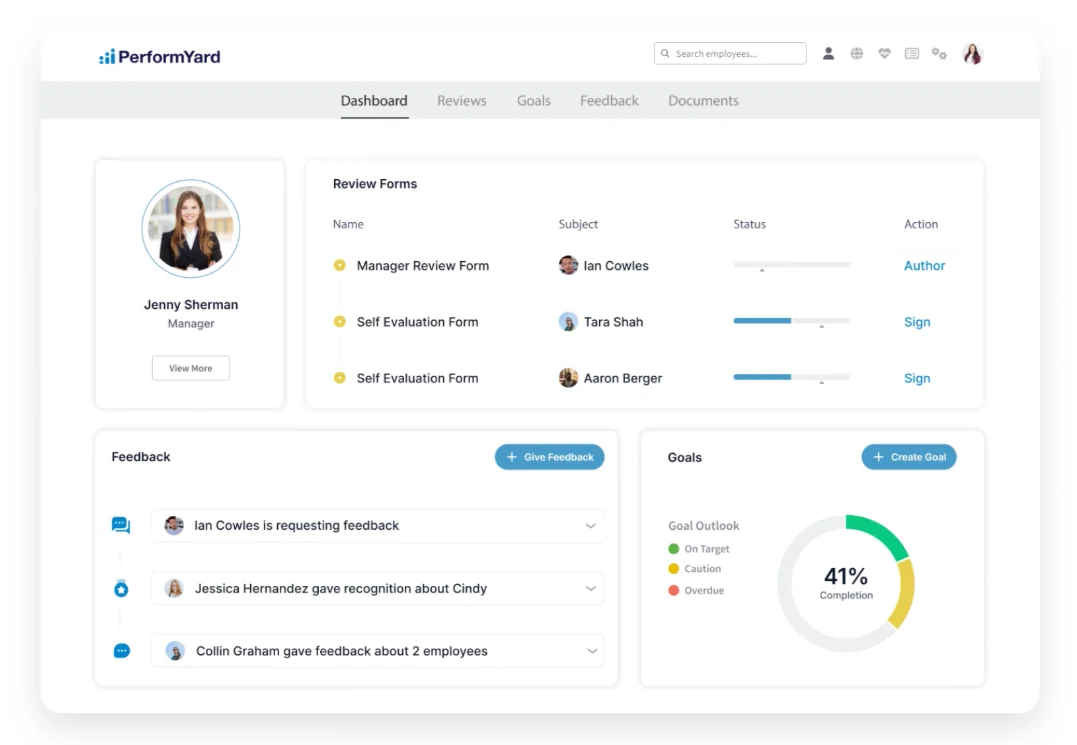
PerformYard
Best forKeeping the review process you already have.
PerformYard is a performance management platform for teams that need more structure around reviews, goals, feedback, and reporting. It works particularly well for project-based and matrix organizations, where feedback may come from managers, peers, clients, or different teams throughout the year.
Why PerformYard is a strong BambooHR alternative
BambooHR supports custom review cycles and questions, but PerformYard gives teams more control over how those cycles run. Reviews can be triggered around projects, milestones, or different employee groups, with several cycles running at the same time.
That makes it useful for companies where performance reviews are more complex than a standard company-wide cycle. HR can collect feedback from different people, connect reviews with goals, and track progress across teams without forcing every employee into the same process.
The narrower focus is worth noting. BambooHR covers a much broader HR stack, while PerformYard keeps its attention on performance and development. Features such as competencies, career paths, succession, and compensation planning sit within its Talent Development offering.
Key PerformYard features
Several review processes run at the same time, such as annual reviews for one group and quarterly check-ins for another
You can adjust forms, stages, ratings, and feedback rules to match how your organization already reviews people
PerformYard AI builds forms, creates goals, generates reports, and summarizes reviews or meetings
Implementation support, unlimited training, and a dedicated success manager are included
Goal management and continuous feedback keep progress visible between formal reviews
Teams can attach competencies and career paths to reviews when they need more structure
Pros
Review cycles can be heavily customized around existing processes
Multiple review types can run at the same time
Onboarding, training, and a dedicated success manager are included
Full performance workflows work through a mobile browser
Cons
PerformYard AI costs an extra $1 to $3 per person per month, and Meetings add $2 to $4
There's no native mobile app
PerformYard pricing
PerformYard bills annually per person:
Performance Management: $5 to $10 per person/month
PerformYard AI: +$1 to $3 per person/month
Employee Engagement: +$1 to $3 per person/month
Meetings or Surveys: +$2 to $4 per person/month
7Review rules by team
Appraisd
Best forRunning different review rules for different employee groups.
Appraisd, now Talos Perform, is a dedicated performance management platform for organizations with roughly 50 to 5,000+ employees. It covers reviews, check-ins, objectives, feedback, development plans, competencies, and career conversations, with HR able to shape the process around different parts of the workforce.
Why Appraisd is a strong BambooHR alternative
Appraisd gives HR more control when different teams need genuinely different performance processes. Reviews can run weekly, monthly, quarterly, or annually by employee group, with calibration, calculated ratings, custom viewing permissions, and external feedback available in the same system.
BambooHR supports multiple review cycles and group-specific questions, but Appraisd goes deeper into how performance programs are configured and governed across teams.
Its AI Notetaker can record review conversations, create structured notes against each review question, and Appraisd says it can cut write-up time by up to 80%.
The catch for smaller teams is the annual commitment. Appraisd currently lists a £4,750 minimum annual agreement for its smallest tier.
Key Appraisd features
Group-specific rules give each team its own review cycle, template, rating scale and workflow
Calibration and calculated ratings keep scoring consistent across teams
The AI Notetaker turns review conversations into editable notes, and Appraisd says this can cut write-up time by up to 80%
HR can run probation reviews, check-ins, 360° feedback and annual cycles differently across teams
Competencies, development plans, career conversations and compensation reviews sit alongside performance data
HRIS connections sync employee records from systems such as Workday, BambooHR and Oracle
Pros
Review templates, workflows, ratings and feedback rules can be adapted for different employee groups
Standard performance, alignment and progression features are included in the core price
The AI Notetaker works for both remote and in-person meetings
The 9-box grid can be configured beyond the standard performance-versus-potential model
Cons
Payroll and broader HR administration need separate software
Contracts are billed annually, and smaller companies still face a minimum annual spend
Appraisd pricing
Appraisd starts at £95 per employee/year, billed annually.
Minimum annual spend: £4,750
Minimum contract: 2 years
AI Notetaker and Rating Calibration cost extra
Enterprise pricing is custom
8HR, IT & finance automation
Rippling
Best forCompanies that want employee changes to trigger work across HR, payroll, IT, devices, apps, and finance.
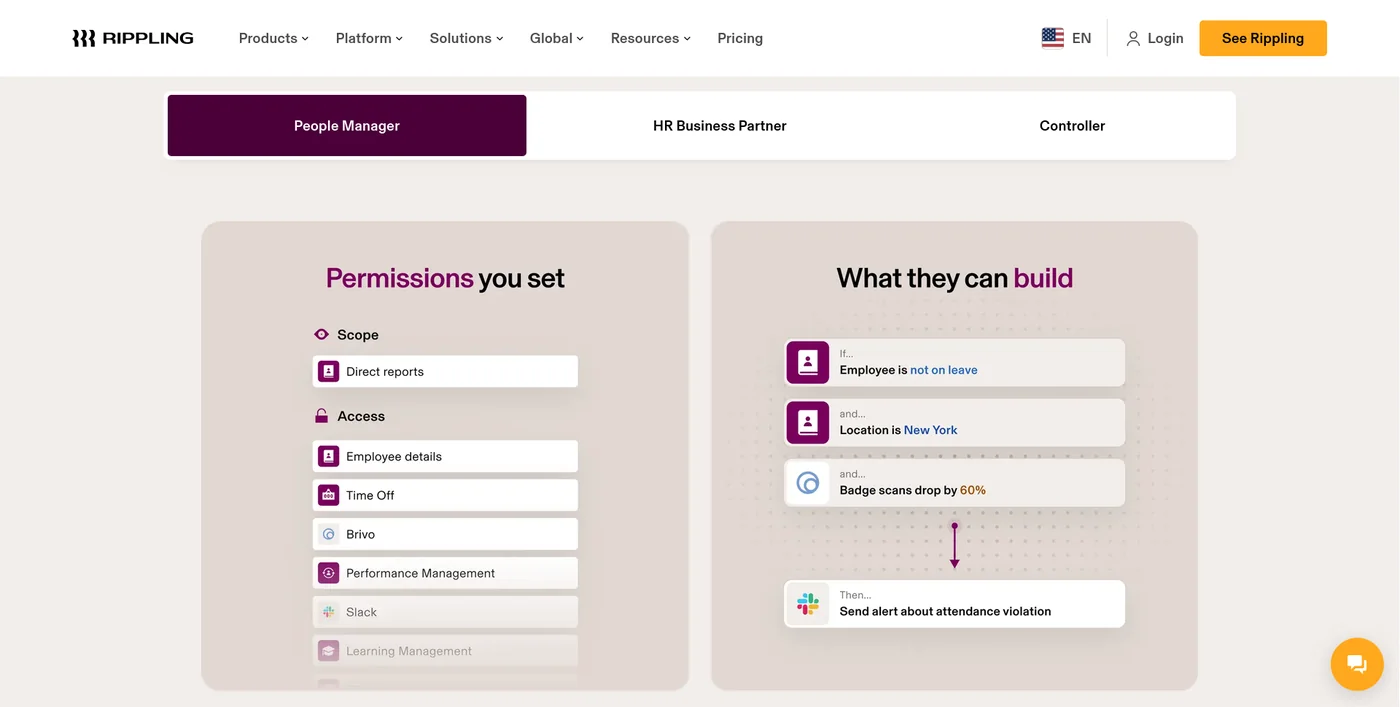
Rippling treats an employee change as an operational event. A new starter can affect payroll, app access, devices, cards, expenses, and HR data at once. A departure can reverse those actions from the same system.
Why Rippling is a strong BambooHR alternative
Rippling is a better fit when you want to manage more than HR in one system. It combines payroll, benefits, IT, app access, device management, and expenses alongside core HR.
Its biggest strength is automation. A new hire can trigger payroll setup, software access, device provisioning, and approval workflows automatically from the same employee record.
That makes Rippling useful for growing teams that want HR and IT to work more closely together.
The main tradeoff is complexity. Rippling has a lot of modules and settings, so setup can take longer and costs can rise as you add more products.
Key Rippling features
HRIS keeps employee records, payroll, benefits, time off, and other workforce data connected in one system.
Workflow Studio automates onboarding, offboarding, approvals, payroll tasks, and other processes across HR, IT, and Finance.
Payroll connects salary changes, benefits deductions, time data, and employee records directly to pay runs.
Benefits Administration handles enrollment, deductions, ACA reporting, COBRA, and other benefits workflows.
Performance Management supports review cycles, calibrations, goals, and compensation discussions.
Time & Attendance tracks hours, policies, overtime, and approved time before syncing it into payroll.
Headcount Planning helps teams plan hiring and control workforce spend from one source of truth.
Custom Reporting lets teams build reports across HR, payroll, recruiting, performance, and workforce data.
Pros
Easy to use, with one login for HR, payroll, IT, and other tools.
Clean interface makes everyday tasks and navigation straightforward.
Employees can quickly access payslips, time tracking, and other common features.
Search, calendars, and self-service tools make routine work faster.
Cons
Reporting and some app features can feel limited or harder to configure.
The number of features creates a learning curve and can make the platform feel complex at first.
Rippling pricing
Rippling uses custom quotes.
9International HCM
HiBob
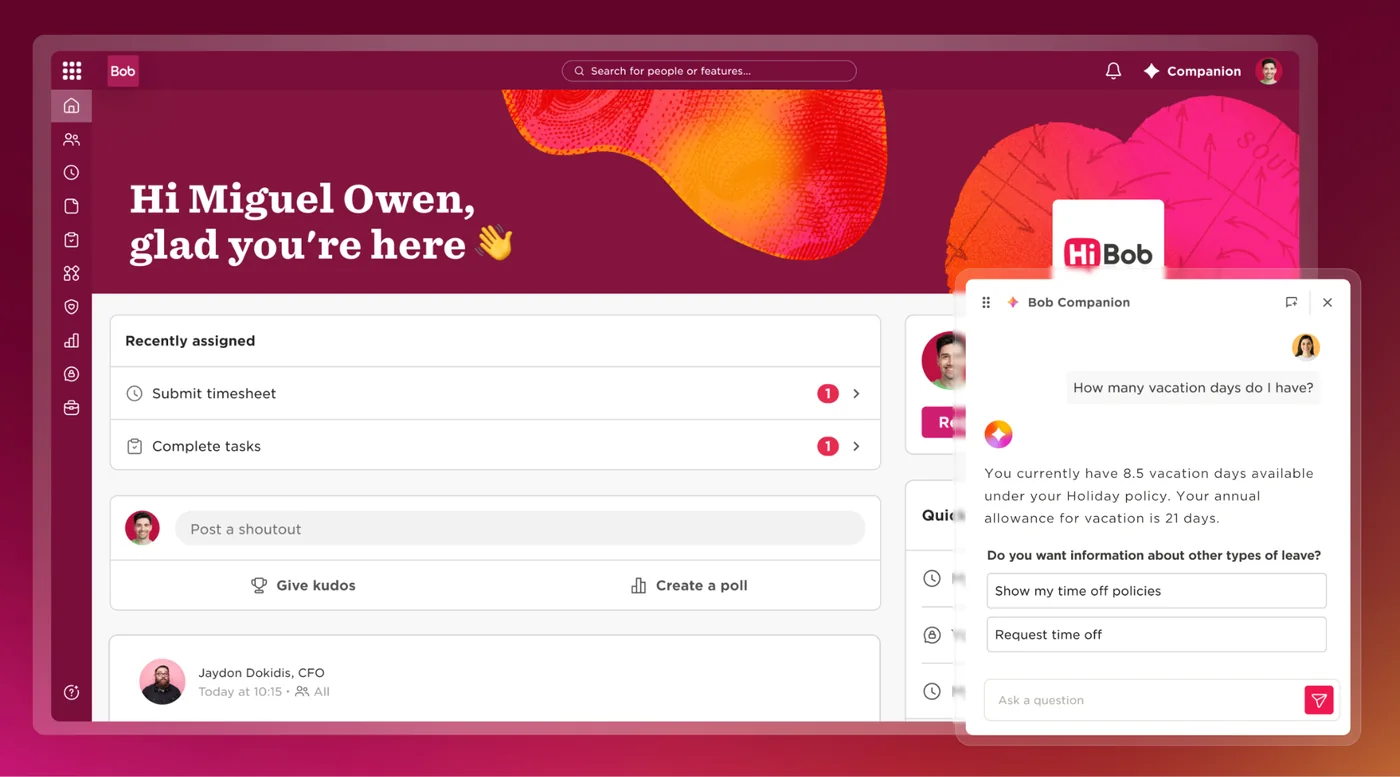
Best forInternational mid-market companies that want HR, talent, compensation, payroll, and workforce planning in the same HCM platform.
HiBob is built for companies where people planning and financial planning sit close together. Headcount, pay, compensation cycles, workforce plans, and employee data can sit inside the same HCM system.
Why HiBob is a strong BambooHR alternative
HiBob is a better match for international companies that need more planning depth around people, pay, and headcount. Compared with BambooHR, it puts more emphasis on workforce planning, compensation, global HR, and multinational reporting within the same platform.
Its Workforce Planning tools support headcount scenarios, position planning, budgets, and approvals, while Compensation and People Analytics help HR connect pay decisions with wider workforce data. HiBob also supports native payroll in the US and UK, with local payroll integrations for other markets.
Where HiBob is less straightforward is pricing. BambooHR publishes its plan rates, while HiBob uses custom quotes and starts with Bob Core before additional modules are added.
Key HiBob features
Bob Core manages employee data, org structures, time off, documents, workflows, and everyday HR tasks in one HRIS.
Talent covers Hiring, Performance, Learning, Surveys, onboarding, goals, and 1:1s across the employee lifecycle.
Workforce Planning supports position planning, headcount scenarios, approval workflows, and workforce forecasting.
Compensation helps teams manage pay bands, compensation cycles, budgets, and pay equity.
People Analytics gives HR live insights into headcount, growth, retention, and absence trends.
Payroll Hub keeps payroll providers connected with HiBob, while native payroll is available in the US and UK.
Pros
Clean, intuitive interface for HR teams and employees.
Good customization for workflows and employee data.
Responsive customer support with helpful guidance.
Strong employee experience and engagement features.
Cons
Customization can feel limited for complex organizations.
Some integrations depend on third-party tools.
HiBob pricing
HiBob uses custom per-employee pricing.
10Payroll-first HR
Gusto
Best forSmall US businesses where payroll, tax filing, benefits, and time are the reason for buying HR software.
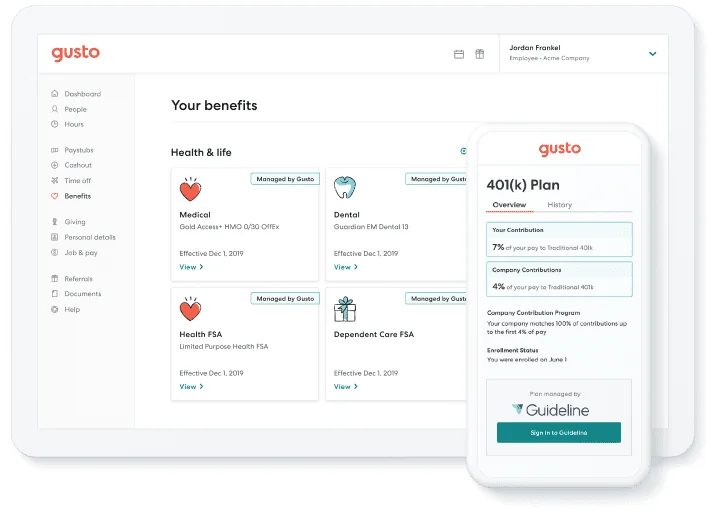
Gusto is easier to understand than many HR suites because payroll is the starting point. Payroll, taxes, time tracking, PTO, and benefits stay connected, so teams do not have to move the same employee data between separate systems. As the business grows, Gusto can then add hiring, onboarding, performance management, and HR support around that same setup.
Why Gusto is a strong BambooHR alternative
The biggest difference is where each platform puts its weight. BambooHR starts with a broader HR system, while Gusto is designed around the day-to-day needs of small US employers.
Gusto adds useful support around that core, including compliance alerts, employee self-service, and access to certified HR professionals. That can make a real difference for smaller teams that do not have a large in-house HR function.
For companies that want a simpler way to manage people and stay compliant, without paying for deeper talent features they may not need, Gusto can be the more practical fit.
Key Gusto features
Full-Service Payroll runs payroll, direct deposits, deductions, and tax filings.
Time & Attendance tracks hours, PTO, and approvals and syncs them to payroll.
Performance Management supports reviews, 360 feedback, goals, and self-evaluations.
Benefits Administration connects health, retirement, workers’ comp, and payroll deductions.
HR Support includes compliance help, employee self-service, and access to HR experts.
Pros
Easy to use, with a clean interface that keeps payroll simple.
Setup is quick and straightforward for small businesses.
Payroll workflows are easy to navigate and manage day to day.
Employee access is simple, with clear self-service options.
Cons
Reporting and expense management can feel limited.
Customer support can be difficult to reach when issues come up.
Gusto pricing
Gusto uses a simple monthly base fee plus a per-person fee.
Simple costs $49/month + $6 per person and covers single-state payroll, tax filing, PTO, and basic reporting.
Plus costs $80/month + $12 per person and adds multi-state payroll, time tracking, and more HR tools.
Premium costs $180/month + $22 per person and adds performance management, compensation, custom reporting, HR experts, and priority support.
11Global employment & EOR
Deel
Best forCompanies managing employees, contractors, EOR workers, and payroll across several countries.
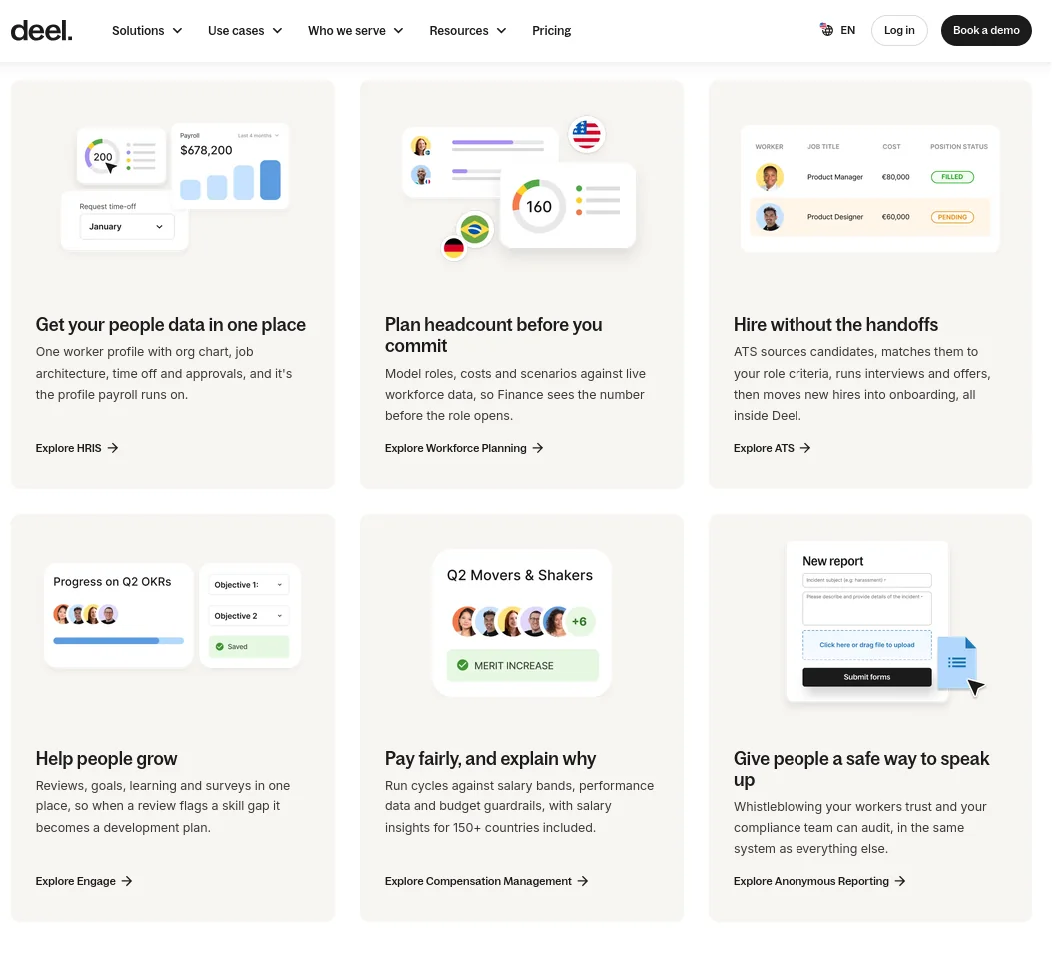
Deel is built for distributed companies that need one place to manage global workforce operations. Worker records, documents, time off, policies, and approvals stay connected, which gives HR a clearer view across countries without relying on separate local systems.
Why Deel is a strong BambooHR alternative
Deel goes further when international employment becomes a core part of the business. Its EOR service covers 130+ countries, while global payroll, contractor payments, compliance, and local employment support all sit within the wider Deel platform.
BambooHR supports global hiring too, but its EOR service is powered by Remote, and international payroll runs through localized payroll partners. Payroll and benefits for EOR employees are still handled in Remote rather than fully inside BambooHR.
That makes Deel a stronger fit for companies expanding into several countries and wanting fewer handoffs between providers. The main limitation is cost, since services such as EOR, Contractor of Record, and global payroll are priced separately.
Key Deel features
Deel HR manages worker profiles, org charts, documents, workflows, time off, approvals, and reporting in one HRIS.
Employer of Record (EOR) lets companies hire full-time employees in 130+ countries without opening local entities.
Contractor Management covers contracts, invoicing, payments in 120+ currencies, and worker classification support.
Global Payroll brings multi-country payroll, workforce costs, and payroll status into one dashboard.
Performance Reviews, Goals, and Learning support employee development and ongoing talent management.
Compensation and Workforce Planning help teams manage pay bands, review cycles, budgets, and headcount planning across countries.
Pros
Deel makes global hiring easier by keeping contracts, onboarding, payroll, and compliance in one place.
Reviewers like the multi-currency payments and flexible payout options for international teams.
The interface is generally easy to use, even when managing contractors and employees across several countries.
Automated payroll and onboarding reduce a lot of manual work for HR teams.
Cons
EOR fees and add-ons can become expensive as international headcount grows.
Support can be slower for country-specific payroll, legal, or compliance issues.
Deel pricing
Deel prices HR software and global employment services separately:
Deel HR Core starts at $5 per employee/month
Contractor Management starts at $49 per contractor/month
Global Payroll starts at $29 per employee/month
US PEO starts at $125 per employee/month
EOR starts at $599 per employee/month
How to choose a BambooHR alternative
Start with the gap you need to solve. BambooHR already covers a lot, so the best alternative is usually the one that goes deeper in your priority area.
If your priority is...
Look at...
Why it fits
Performance, competencies, development, succession, and frontline access
Combines EOR, contractors, payroll, and global compliance
Our verdict
StaffCircle: Best BambooHR alternative for performance and development across office and frontline teams
StaffCircle works well for teams that want more depth around skills, competencies, development, and succession without replacing their core HR system.
It can sit alongside BambooHR, keeping employee records and admin in one place while StaffCircle handles reviews, objectives, competency data, and development planning.
Iglu, with more than 400 employees, uses this setup. It kept BambooHR for core HR and added StaffCircle for skills-based reviews, competency frameworks, employee objectives, and regular skills snapshots.
That gave HR better visibility into development needs without rebuilding the wider HR stack.
BambooHR is still the broader choice for core HR, payroll, and benefits. StaffCircle fits better when the main need is stronger performance and employee development. Request a StaffCircle demo to see how the two can work together!
FAQs about BambooHR alternatives
We already use BambooHR. When is StaffCircle the better move?
StaffCircle is the better move when appraisals are only the starting step. If your team wants performance data to feed competencies, development plans, career paths, and succession, StaffCircle goes further into that process while also covering everyday HR administration.
Can StaffCircle take over from BambooHR, or would we need both?
It can take over for companies using BambooHR mainly for employee data, onboarding, absence, documents, performance, development, and engagement. If payroll or recruiting is a major part of your setup, those can stay with connected systems.
We have teams in several countries. Should we look at Deel or HiBob?
Choose Deel when EOR, contractors, and international payroll are driving the purchase. HiBob suits companies that want international HR, talent, compensation, payroll, and workforce planning inside one HCM platform.
See why teams add StaffCircle to BambooHR
Book a 30-minute walkthrough and we'll show you exactly how StaffCircle compares for your organisation.