Employee Onboarding Checklist: the First 90 Days, Week by Week
Many onboarding checklists say little after the first week and assume everyone sits at a desk. This one runs from the accepted offer to day 90, says who owns each task and by when, and gives hybrid and frontline starters their own track.
- Pre-boarding, day-one and week-one checklists with an owner and a deadline on every task
- The UK legal items and when they are due: written statement, right to work, payroll and pension
- Separate tracks for office, hybrid and frontline or shift starters
- A week-by-week plan from week 2 to week 13, with 30, 60 and 90-day milestones
- Check-in questions and a 90-day review form with sign-off
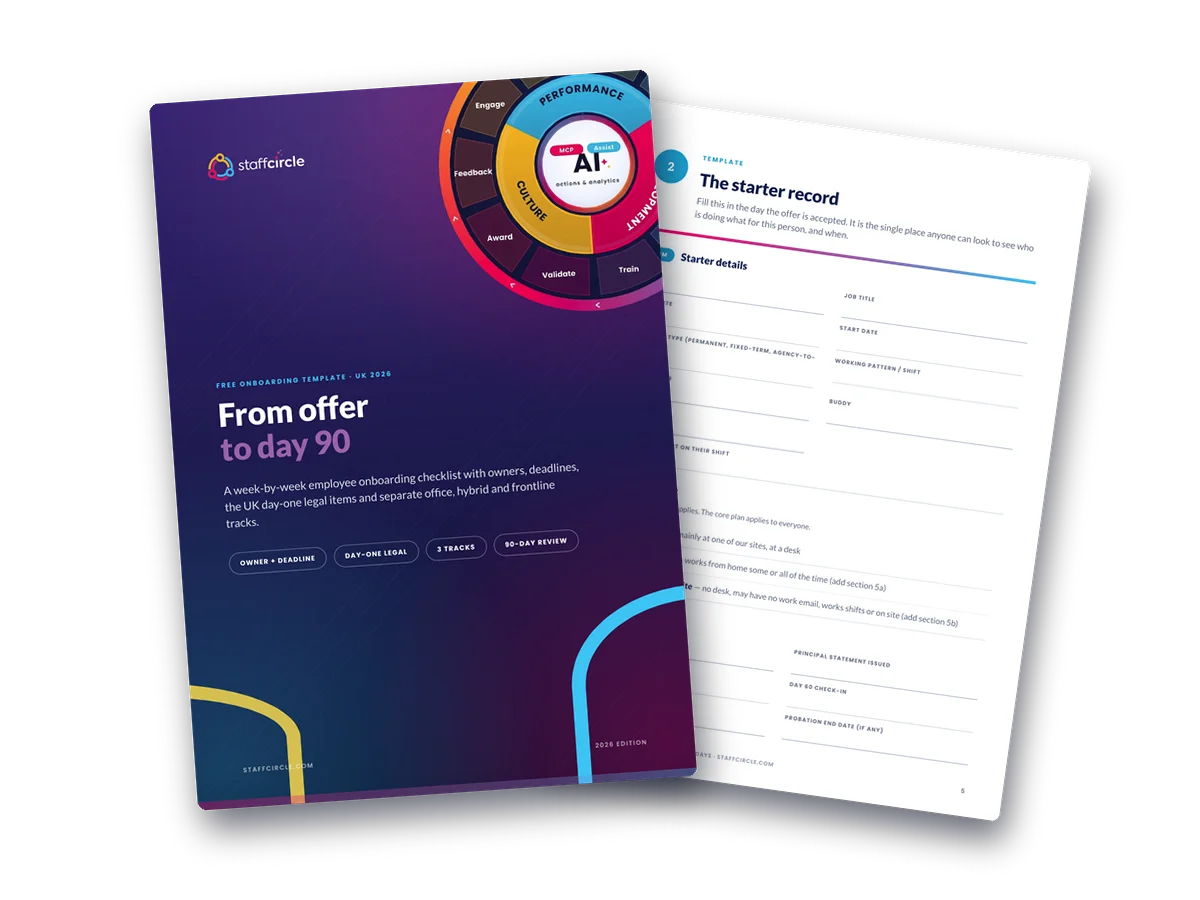
Get your free template
Fill in your details to get the PDF and the editable Word version. We’ll email you the PDF too.
We’ll only use your details to send the template and relevant StaffCircle content. See our privacy policy.
Trusted by teams at leading organisations


Early leavers and early risks
Seven sections, ready to print or edit
The 90 days at a glance
What the law needs and when, who owns what, and how onboarding, induction and probation fit together.
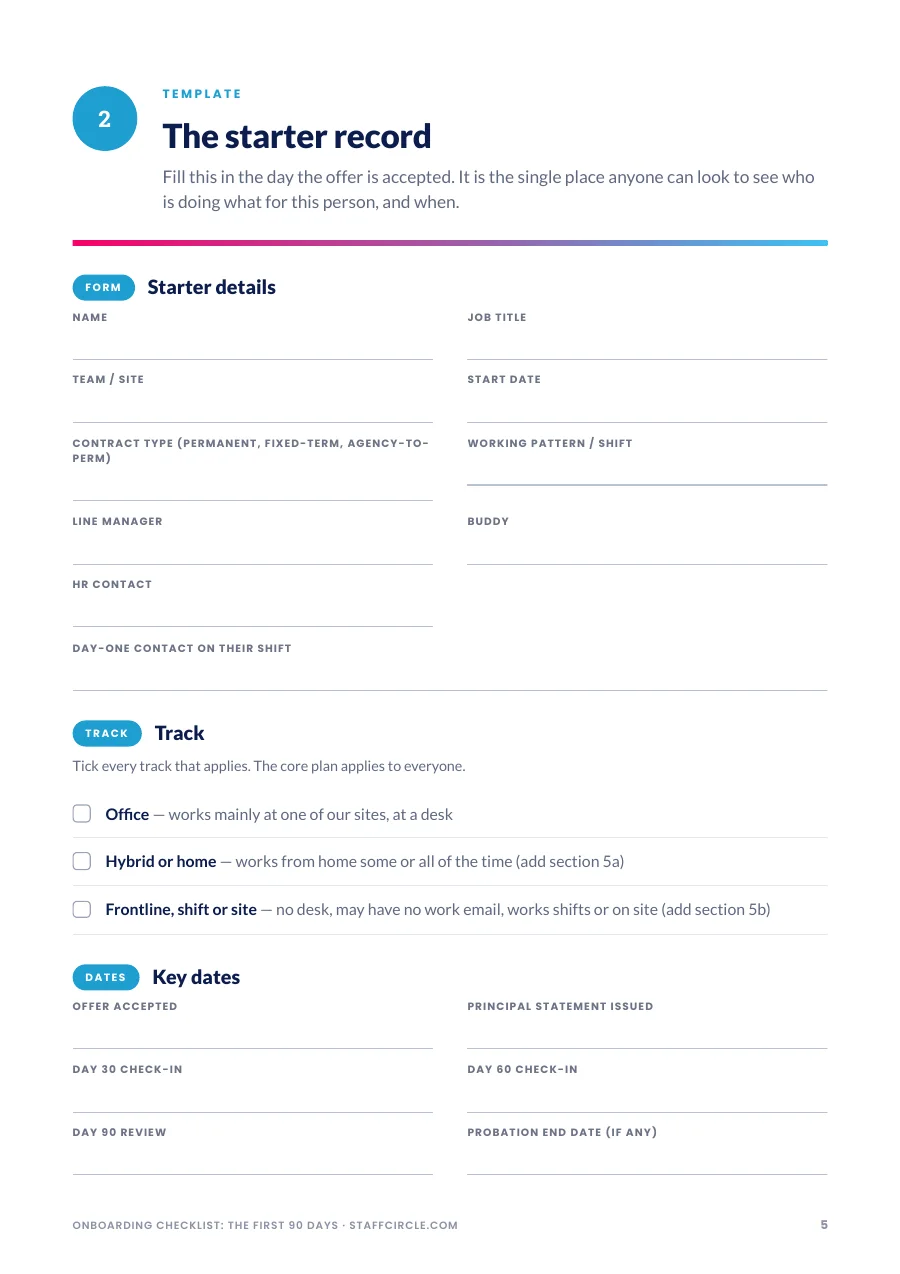
Starter record
One page that names the owner, buddy, track and key dates for each new starter.
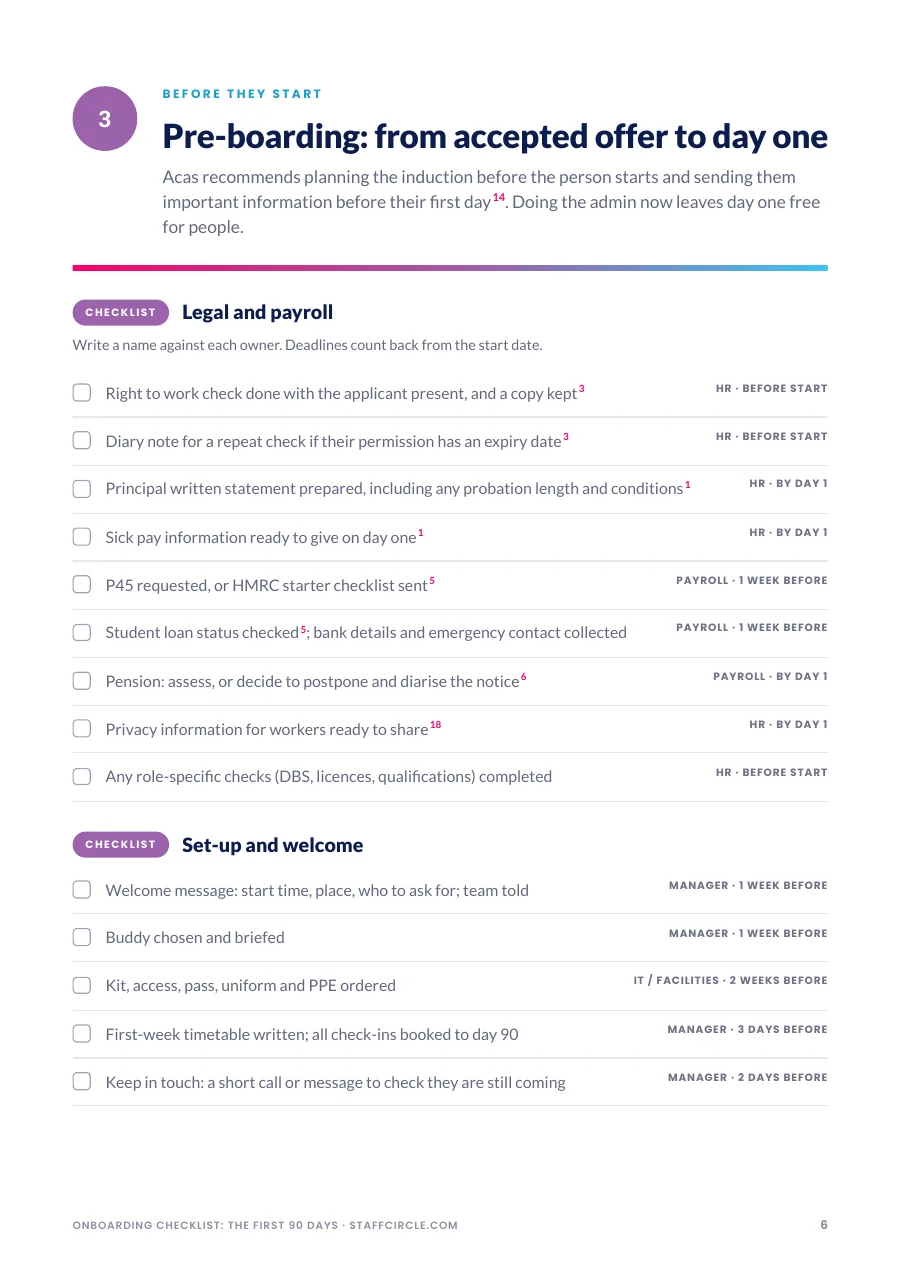
Before day one
Legal, payroll and set-up tasks from accepted offer to first morning, each with an owner and a deadline.
Day one and week one
A first day that is not overloaded, and a first week that ends with a proper check-in.
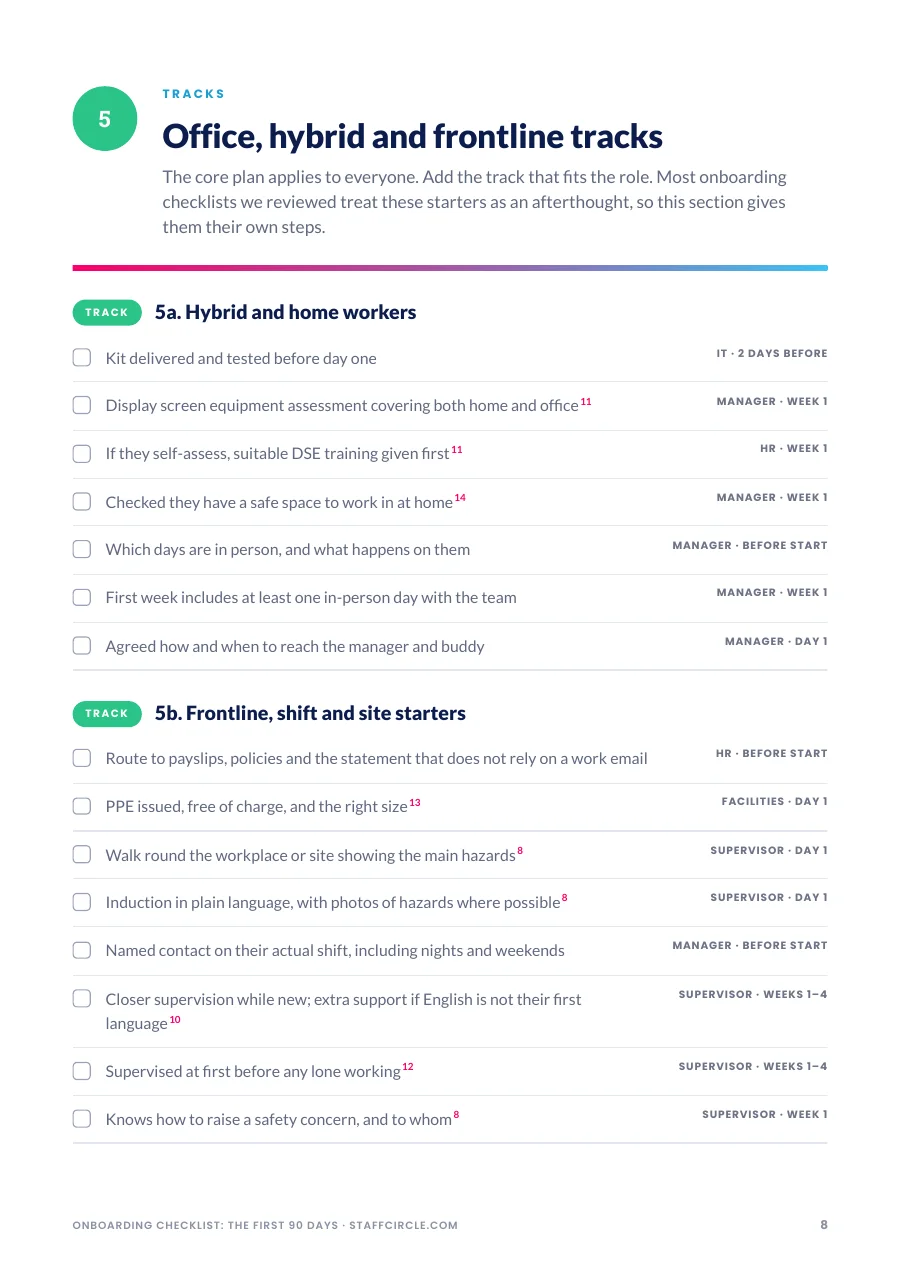
Office, hybrid and frontline tracks
Extra steps for home workers, and for shift, site and deskless starters with no work email.
Weeks 2 to 13 and the 90-day review
A week-by-week plan, check-in questions, a rating grid and sign-off.
Onboarding that lasts longer than the first morning
A good onboarding checklist answers three questions for every task: what needs doing, who is doing it, and by when. Most only answer the first.
Search for an employee onboarding checklist and you will find plenty of lists. Many start on the first morning and say little after the first week or two, and assume the new starter has a desk, a laptop and a work email address. Few give every task both an owner and a deadline, and few break days 30 to 90 down week by week.
That matters because people can and do leave early. CIPD research found that 41% of employers who had recruited in the past year had experienced new employees resigning within the first 12 weeks, and 27% of employers trying to fill vacancies had new starters fail to turn up on day one (CIPD, 2024).
Start before day one
Some of the most important onboarding tasks are legal, and several fall due before or on the first day. You must check that someone has the right to work in the UK before you employ them (GOV.UK). The principal written statement of employment particulars must be provided on the first day of employment, and a wider written statement follows within two months (GOV.UK). Payroll needs a P45 or HMRC’s starter checklist, and you must tell HMRC about the new employee on or before their first pay day (GOV.UK).
Acas also recommends sending the new worker important information before their first day, and avoiding giving too much information on the first day itself (Acas). Spreading the load across pre-boarding and the first week makes day one about people, not paperwork.
Give every task an owner
Onboarding fails quietly when everyone assumes someone else has done it. The template gives every line an owner (HR, line manager, IT or facilities, payroll or the buddy) and a deadline relative to the start date, so it works whether someone starts next Monday or in three months.
One plan, three tracks
The core plan is the same for everyone. On top of it sit two extra tracks:
- Hybrid and home workers. Kit delivered and tested before day one, and a display screen equipment assessment that covers both home and office, as HSE guidance expects where people use DSE in both places.
- Frontline, shift and site starters. A route to policies and payslips that does not rely on email, free PPE that fits, a walk round the main hazards, a named contact on their actual shift, and closer supervision while they are new.
If your teams work shifts or on site, our probation review questions for site and shift workers pick up where this checklist ends, and our guide to onboarding remote workers goes deeper on the home-working side.
Plan to day 90, and line it up with probation
Acas is clear that an induction is not the same thing as a probation period, though the two might happen at the same time (Acas). From 1 January 2027 employees will be able to claim unfair dismissal after six months in a job, instead of two years (Acas). A 90-day plan with recorded check-ins at weeks 1, 4, 8 and 13 gives you a clear picture well before that point.
- Fill in the starter record the day the offer is accepted.
- Work through the pre-boarding checklist, assigning each owner.
- Pick the track that fits the role and add its checklist.
- Book every check-in in the calendar before day one.
- Close with the 90-day review and agree what happens next.
New to the topic? Our explainer on what onboarding is covers the basics. The template is free as a branded PDF and an editable Word file. Check acas.org.uk and GOV.UK for the latest guidance before you rely on any legal date.
Employee onboarding: common questions
What should be on an employee onboarding checklist?
The legal and payroll tasks (right to work check, written statement, P45 or starter checklist, pension assessment, privacy information), set-up tasks such as equipment, access and a buddy, a planned first day and first week, and scheduled check-ins through to around day 90. Each task should have a named owner and a deadline.
How long should onboarding last?
There is no legal length. A 90-day plan covers the first 12 weeks, when CIPD found 41% of recruiting employers had seen new starters resign, and leaves time for several recorded check-ins before any probation decision.
Is onboarding the same as induction?
Acas describes induction as the process of welcoming someone to an organisation or role and says it is sometimes called onboarding. There is no legal requirement to have an induction, though HSE says new recruits should be included in health and safety training. An induction is also not the same thing as a probation period.
Do I have to give a written statement on day one?
Yes. GOV.UK says the employer must provide the principal statement on the first day of employment, including details such as pay, hours, holiday, any probation period and obligatory training. A wider written statement, covering things like pensions and disciplinary and grievance procedures, must follow within two months.
When should I do a right to work check?
Before you employ the person. GOV.UK says you must check that a job applicant is allowed to work for you in the UK before you employ them, and you could face a civil penalty of up to £60,000 for each illegal worker if you cannot show correct checks. The Home Office updated its employer guidance in October 2026, so check GOV.UK for the latest version.
What if a new starter does not have a P45?
Use HMRC’s starter checklist instead. You must tell HMRC about the new employee on or before their first pay day, using a Full Payment Submission.
When must a new starter join the workplace pension?
Your automatic enrolment duties apply from the start, but The Pensions Regulator allows you to postpone working out who to put into a scheme for up to three months, starting as early as the person’s first day. If you postpone, you have six weeks to write to them from the date after postponement starts.
How is onboarding different for frontline and shift workers?
Frontline starters may have no work email, may start on a night or weekend shift, and need PPE and a walk round the hazards. HSE says new and inexperienced workers may need more supervision, and PPE used only at work must be free. Plan a non-email route to policies and payslips and a named contact on their shift.
Should probation end before six months?
There is no legal requirement to have a probation period. From 1 January 2027, employees can claim unfair dismissal after six months in a job, and Acas notes that employers might want probation periods to end before someone gets that protection. Take advice on individual cases.
Give every new starter a proper first 90 days
Pre-boarding to day 90 checklists, three tracks, check-in questions and a 90-day review, as PDF and Word.